

Measuring Resistance
1. Aim
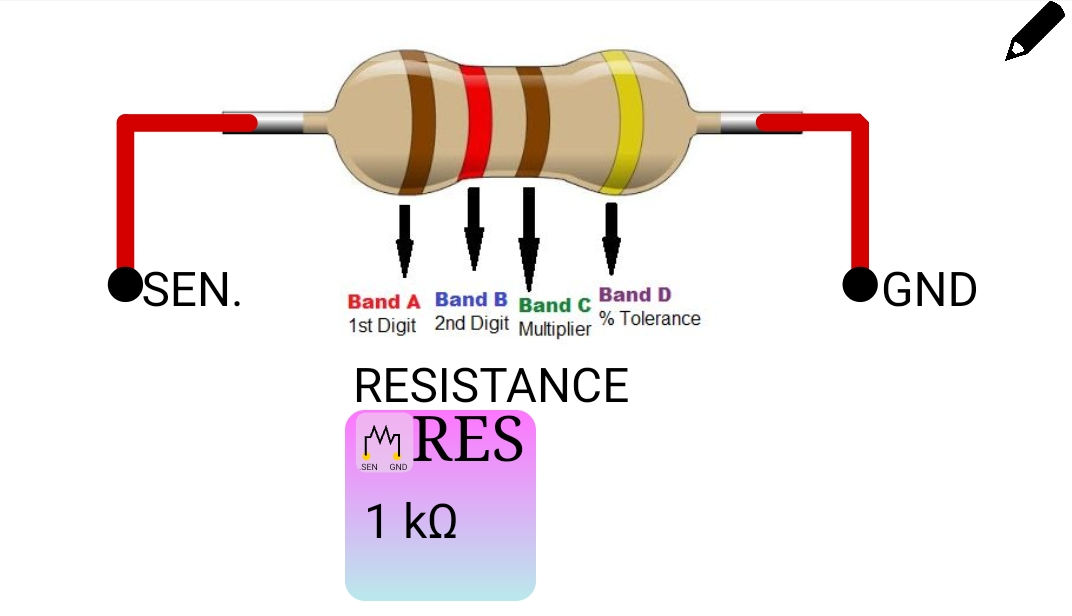
To measure an unknown resistance connected between SEN and GND using SEELab/ExpEYES.
2. Apparatus / Components Required
- SEELab3 or ExpEYES-17 unit
- Resistors (typical range: 100 ohm to 100 kohm)
- Connecting wires
- PC/Laptop/Android phone with SEELab software
3. Theory & Principle
Inside ExpEYES, SEN is connected to 3.3V through an internal 5.1 kohm resistor.
When an unknown resistor R is connected from SEN to GND, a voltage divider is formed.
Hence, \(R=5100\cdot\frac{V_{SEN}}{3.3-V_{SEN}}\)
Best accuracy is obtained when R is of the same order as 5.1 kohm.
4. Circuit Diagram / Setup
- Connect one terminal of unknown resistor to
SEN. - Connect other terminal to
GND. - Open “Measure Resistance” in software/app.
5. Procedure
- Start with a known resistor (for example
1 kohm) for verification. - Note displayed resistance.
- Repeat for
470 ohm,2.2 kohm,10 kohm,47 kohm. - Compare measured and nominal values.
- For unknown resistor, repeat measurement 3 times and average.
6. Observation Table
| Nominal Resistance | Measured Resistance | % Error | Remarks |
|---|---|---|---|
| 470 ohm | |||
| 1 kohm | |||
| 2.2 kohm | |||
| 10 kohm | |||
| 47 kohm |
7. Series and Parallel Combinations
Use two known resistors (example: R1 = 1 kohm, R2 = 2.2 kohm) and verify equivalent resistance.
For series: \(R_{series}=R_1+R_2\)
For parallel: \(R_{parallel}=\frac{R_1R_2}{R_1+R_2}\)
Procedure:
- Measure
R1andR2individually. - Connect
R1andR2in series betweenSENandGND, then measure. - Connect
R1andR2in parallel betweenSENandGND, then measure. - Compare measured equivalents with calculated values.
| Combination | Calculated Equivalent | Measured Equivalent | % Error |
|---|---|---|---|
R1 alone |
|||
R2 alone |
|||
R1 + R2 (series) |
|||
R1 || R2 (parallel) |
8. Advanced: Manual Calculation from SEN Voltage
If software shows V_SEN, calculate R manually using:
\(R=5100\cdot\frac{V_{SEN}}{3.3-V_{SEN}}\)
Example: if V_SEN = 1.65V,
\(R=5100\cdot\frac{1.65}{1.65}=5100\ \Omega\)
9. Error Analysis
- Measurement is less accurate at very low (
<<100 ohm) or very high (>>100 kohm) resistance. - Lead/contact resistance affects low-value measurements.
- Internal resistor tolerance and ADC resolution introduce small errors.
10. Precautions
- Keep resistor leads firm and clean.
- Do not apply external voltage directly to
SENin this experiment. - Use dry fingers / insulated clips; finger touch may alter high values.
11. Troubleshooting
| Symptom | Possible Cause | Corrective Action |
|---|---|---|
| Reads nearly 0 ohm | Short circuit in wiring | Recheck connections |
| Reads very high / overflow | Open circuit / loose lead | Tighten clips |
| Reading unstable | Poor contact | Clean terminals and reconnect |
12. Viva-Voce Questions
Q1. Why is resistance measured between SEN and GND?
Ans: Because SEN has a known internal resistor to 3.3V, making a divider with the unknown resistor to GND.
Q2. Why is measurement most accurate near a few kohms?
Ans: Maximum sensitivity occurs when unknown resistance is comparable to the internal 5.1 kohm resistor.
Q3. What is the approximate measurable range?
Ans: Roughly 100 ohm to 100 kohm for useful accuracy.