

Study of Light Dependent Resistor (LDR)
1. Aim
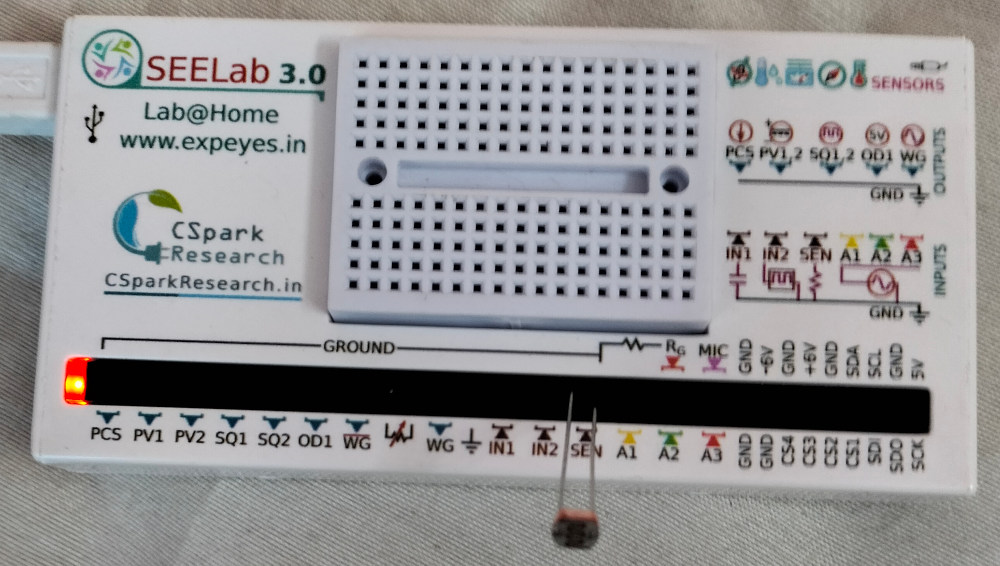
To study variation of LDR resistance with light intensity using SEN and GND.
2. Apparatus / Components Required
- SEELab3 or ExpEYES-17 unit
- LDR
- Connecting wires
- Light source (phone torch / LED lamp)
- PC/Laptop/Android phone with SEELab software
3. Theory & Principle
LDR resistance decreases when light intensity increases.
In this experiment, LDR is connected between SEN and GND. Internally, SEN is connected to 3.3V through 5.1 kohm.
From measured V_SEN, LDR resistance is:
\(R_{LDR}=5100\cdot\frac{V_{SEN}}{3.3-V_{SEN}}\)
Lower light -> higher R_LDR -> higher V_SEN trend depends on divider orientation; verify experimentally.
4. Circuit Diagram / Setup
- Connect LDR between
SENandGND. - Open resistance/LDR measurement screen in software.
- Ensure ambient light condition is stable before taking readings.
5. Procedure
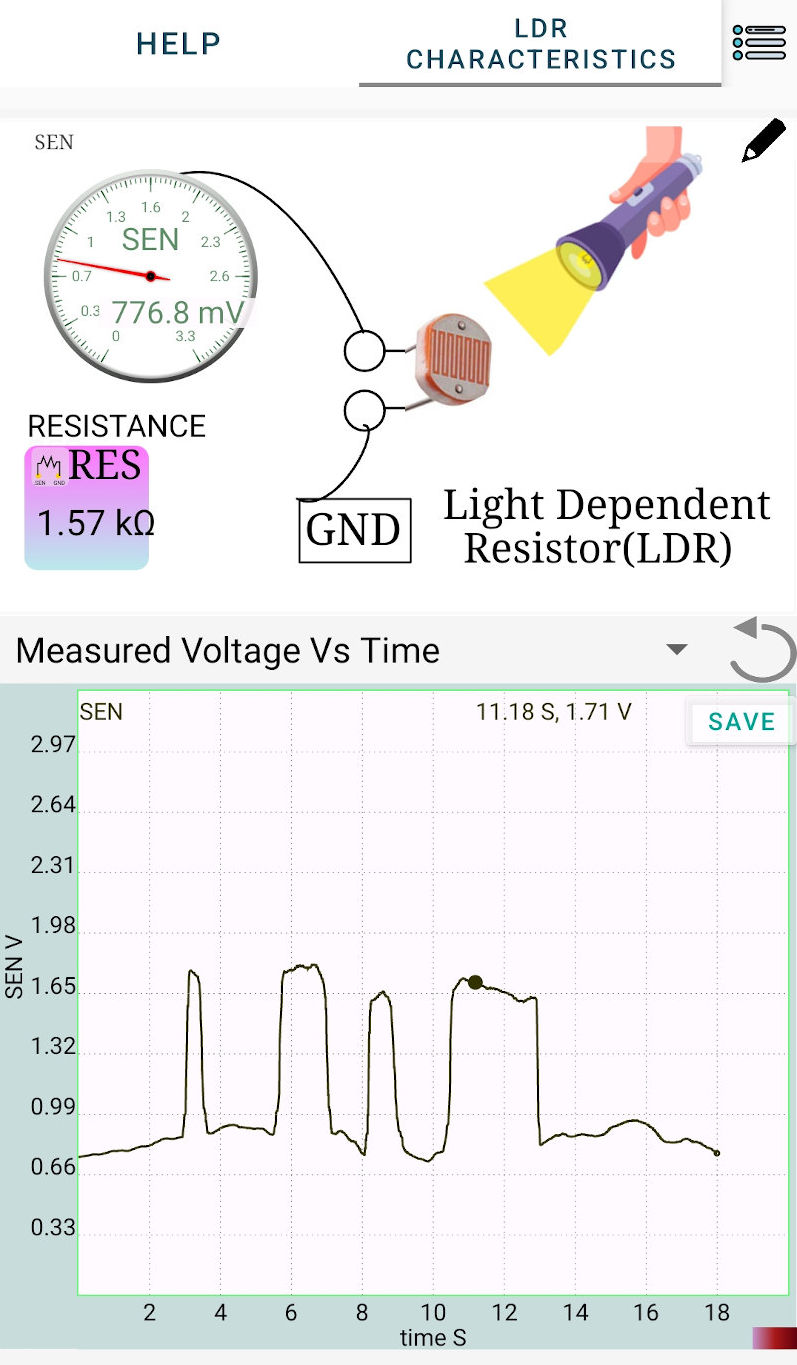
- Record reading in room light.
- Increase light on LDR (torch close to LDR) and record reading.
- Reduce light (cover partly or move source away) and record reading.
- Repeat for multiple light levels.
- Plot
R_LDRvs relative light level (low/medium/high) or lux (if lux meter is available).
6. Observation Table
| Light Condition | Measured $V_{SEN}$ | Calculated / Displayed $R_{LDR}$ | Remarks |
|---|---|---|---|
| Dark / covered | |||
| Room light | |||
| Bright lamp | |||
| Torch very close |
7. Advanced: Sensitivity Estimation
Estimate change ratio: \(\text{Sensitivity ratio}=\frac{R_{\text{dark}}}{R_{\text{bright}}}\)
Larger ratio indicates better light sensitivity.
If multiple points are taken, a log plot (\log R vs \log L) can be used to estimate empirical exponent:
\(R\propto L^{-k}\)
8. Error Analysis
- Ambient light fluctuations cause drift.
- Sensor heating or light-source flicker changes reading.
- Shadows and angle of incidence affect effective illumination.
9. Precautions
- Keep light source distance fixed for repeated trials.
- Avoid hand shadow while recording.
- Wait 1-2 seconds after changing light before reading.
- Do not apply external voltage directly to
SEN.
10. Troubleshooting
| Symptom | Possible Cause | Corrective Action |
|---|---|---|
| No variation in reading | Wrong wiring / faulty LDR | Recheck LDR between SEN and GND |
| Reading very noisy | Flickering light source | Use steady DC light source |
| Saturated high/low value | Too dark / too bright constantly | Adjust illumination range |
11. Viva-Voce Questions
Q1. What happens to LDR resistance when light increases?
Ans: LDR resistance decreases as light intensity increases.
Q2. Why is SEN used in this experiment?
Ans: SEN has a known internal resistor to 3.3V, allowing resistance estimation from measured voltage.
Q3. Why can two readings differ even at same lamp brightness?
Ans: Distance/angle changes, ambient light, and LDR response time can alter readings.