

Measurement of AC Resistance / Impedance of the Human Body
1. Aim
To estimate the human body’s AC impedance using SEELab3 with an AC source (WG) and the built-in high input impedance at A2.
2. Apparatus / Components Required
- SEELab3 or ExpEYES-17 unit
- Connecting wires and two metal electrodes (coins/plates/strips)
- PC / Laptop / Android with SEELab3 software
3. Theory & Principle
This is a measurement using a voltage divider model:
- The human body behaves like an impedance $Z_{body}$.
- The SEELab3 input at A2 has a known input impedance $R_{in}$, typically about $1\text{ M}\Omega$.
Let:
- $V_{A1}$ = RMS voltage at A1 (across the whole divider)
- $V_{A2}$ = RMS voltage at A2 (across $R_{in}$)
Current through the series path is: \(I=\frac{V_{A2}}{R_{in}}\)
Voltage across the body is: \(V_{body}=V_{A1}-V_{A2}\)
So the estimated impedance is: \(Z_{body}=\frac{V_{body}}{I}=(V_{A1}-V_{A2})\cdot\frac{R_{in}}{V_{A2}}\)
For comparison/learning (at moderate frequency like 1000 Hz), $Z_{body}$ can be reported in kilo-ohms.
4. Circuit Diagram / Setup
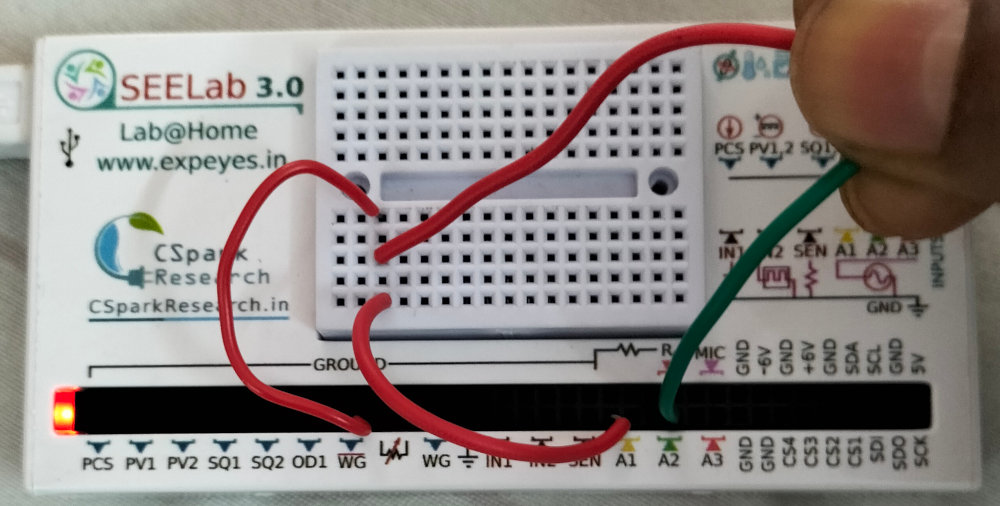
- Connect the AC source WG (sine wave) to one electrode and also to A1 for monitoring.
- Connect the other electrode to A2.
- Ensure SEELab3
GNDreference is correctly wired (as per your hardware). - Keep electrode contact area similar between trials.
5. Procedure
- Launch the SEELab3 app and open the AC resistance / impedance measurement screen (or oscilloscope/plot mode with $V_{rms}$ readouts).
- Set:
- WG frequency =
1000 Hz - WG amplitude = start with a moderate value so RMS voltages stay within A1/A2 range.
- WG frequency =
- Enable analysis/readout for:
- A1 (input RMS)
- A2 (output RMS)
- Touch the electrodes with intact skin and hold contact stable for 3–5 seconds.
- Record:
- $V_{A1,\text{rms}}$
- $V_{A2,\text{rms}}$
- Calculate $Z_{body}$ using $R_{in}=1\text{ M}\Omega$: \(Z_{body}=(V_{A1}-V_{A2})\cdot\frac{10^6}{V_{A2}}\)
- Repeat for different contact conditions (dry, wet, increased contact area).
6. Observation Table
Reference: $R_{in} = 1.0\text{ M}\Omega$
| Condition | $V_{A1}$ RMS (V) | $V_{A2}$ RMS (V) | Estimated $Z_{body}$ (k$\Omega$) | Remarks |
|---|---|---|---|---|
| Dry hands | ||||
| Dry hands with coin/contact increase | ||||
| Wet hands |
7. Precautions
- Use only the low voltage AC output from SEELab3 (WG). Never connect to AC mains.
- Do not touch with cut/bruised skin or if you have any wound.
- Keep contact stable to avoid large fluctuations.
8. Error Analysis
- At AC frequencies, the body impedance includes non-resistive components (skin capacitance), so $Z_{body}$ is an approximation.
- Contact pressure and contact area change $Z_{body}$ during measurement.
- Noise/trigger settings can affect RMS estimation.
9. Troubleshooting
| Symptom | Possible Cause | Corrective Action |
|---|---|---|
| RMS values look wrong or unstable | Weak/no contact between electrodes and skin | Reposition electrodes; maintain steady touch |
| $V_{A2}$ is very small | Divider is not formed correctly | Verify WG→electrode→body→A2 path |
| Computed $Z_{body}$ is unrealistically low/high | Wrong electrode polarity or wiring | Swap electrode connections and retake |
10. Viva-Voce Questions
Q1. Why do we need the high input impedance at A2?
Ans: Human body resistance is typically very high (often in the M$\Omega$ / hundreds of k$\Omega$ range). A high $R_{in}$ ensures the divider current is measurable and the voltage drop can be detected.
Q2. Derive the formula for $Z_{body}$ from $V_{A1}$ and $V_{A2}$.
Ans: Current is $I=V_{A2}/R_{in}$. Body voltage is $V_{body}=V_{A1}-V_{A2}$. So $Z_{body}=V_{body}/I=(V_{A1}-V_{A2})\cdot R_{in}/V_{A2}$.
Q3. Why does wetting hands decrease the measured resistance?
Ans: Water (with dissolved salts) improves ionic conduction through skin, reducing resistance/impedance and increasing divider current.
Q4. Is $Z_{body}$ purely resistive at AC?
Ans: No. Skin and electrode interfaces add non-ideal effects (capacitive/complex impedance), but divider-based measurement still gives a useful estimate for comparison.