
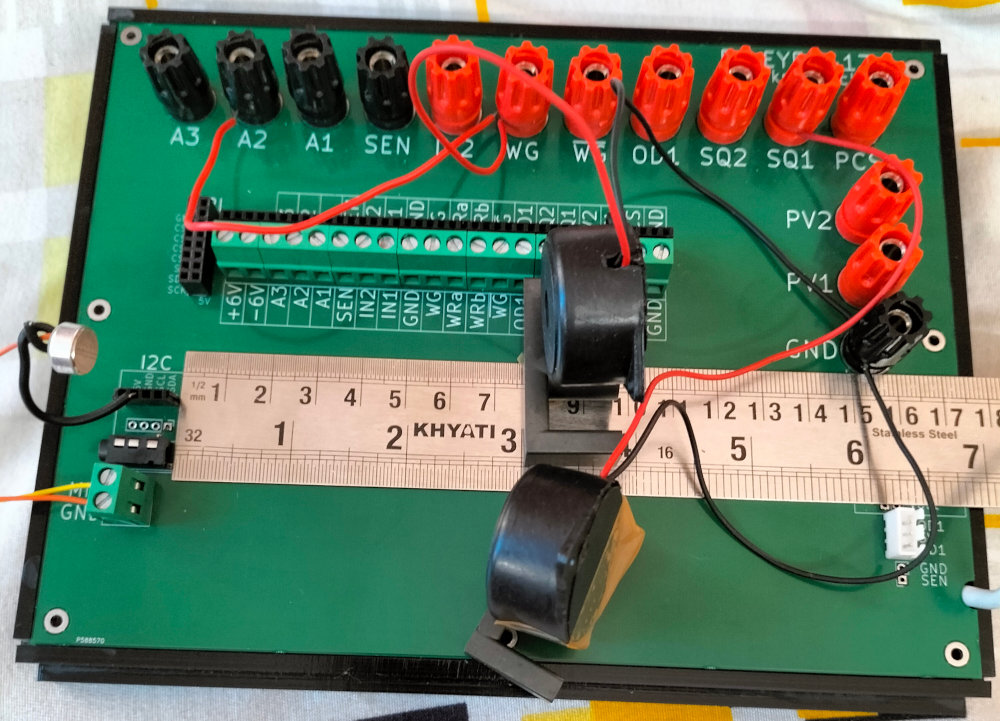
Experiment: Interference of Sound (Beats)
1. Aim
To observe acoustic beats formed by superposition of two nearby frequencies and verify that beat frequency equals frequency difference.
2. Apparatus / Components Required
- SEELab3 unit
- Two piezo buzzers
- Microphone module
- Mounting wire/support for microphone near I2C socket
- Connecting wires
3. Theory & Principle
When two sinusoidal waves of close frequencies $f_1$ and $f_2$ superpose, the resultant amplitude varies slowly, producing beats.
\[f_{beat} = |f_1 - f_2|\]In this setup, typical drive values are around:
- buzzer 1: 3300 Hz sine
- buzzer 2: 3400 Hz square/sine
Expected beat frequency is approximately 100 Hz.
4. Circuit Diagram / Setup
- Connect both buzzers to signal outputs as per ExpEYES arrangement.
- Place microphone between/near the two buzzers and secure mechanically.
- Adjust relative distances to maximize envelope visibility.
- Capture waveform and FFT using SEELab interface.
5. Procedure
- Set two close but distinct frequencies.
- Start acquisition and observe amplitude modulation envelope.
- Measure time between successive envelope maxima to get beat period $T_b$.
- Compute beat frequency:
-
Verify against $ f_1-f_2 $. - Open FFT and confirm both source frequency peaks are present.
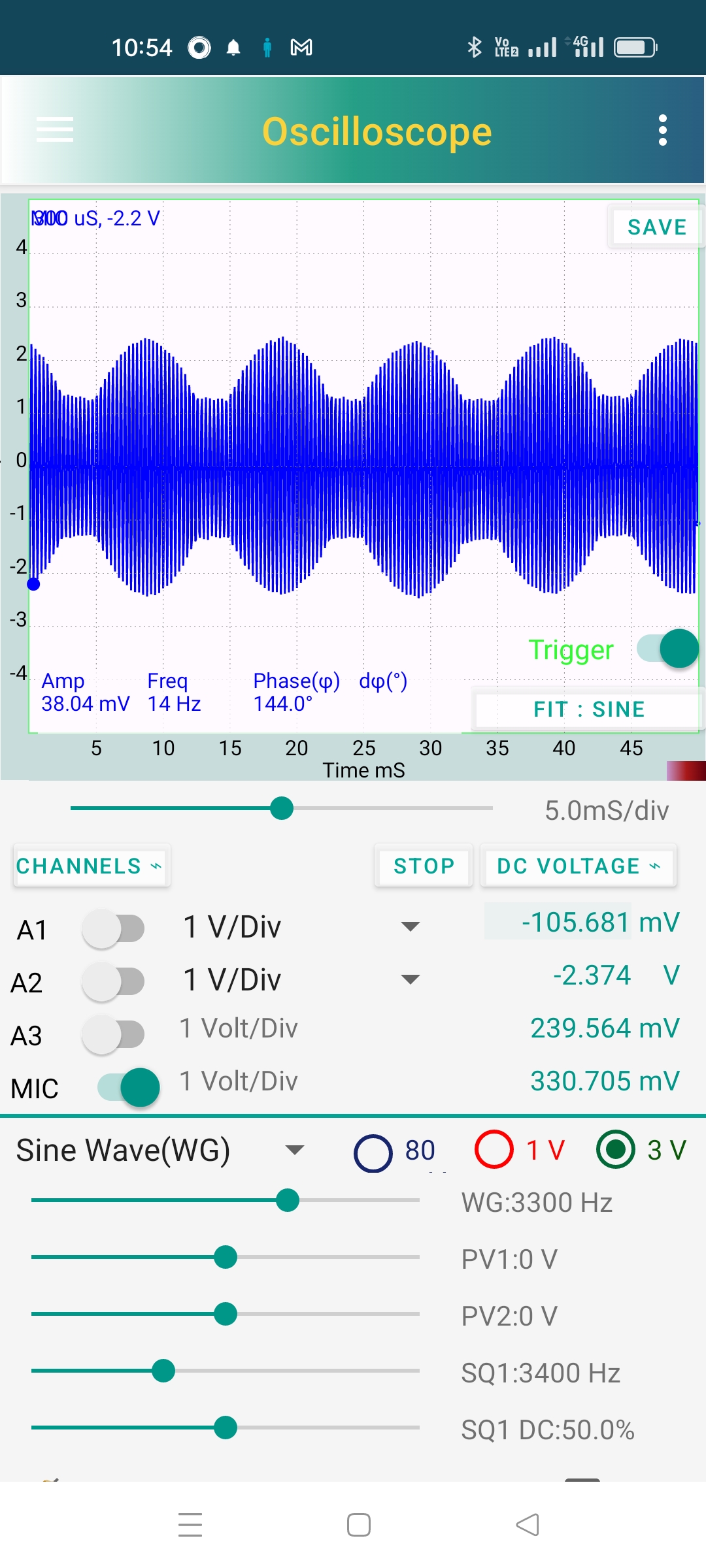
Waveform with Beat Envelope
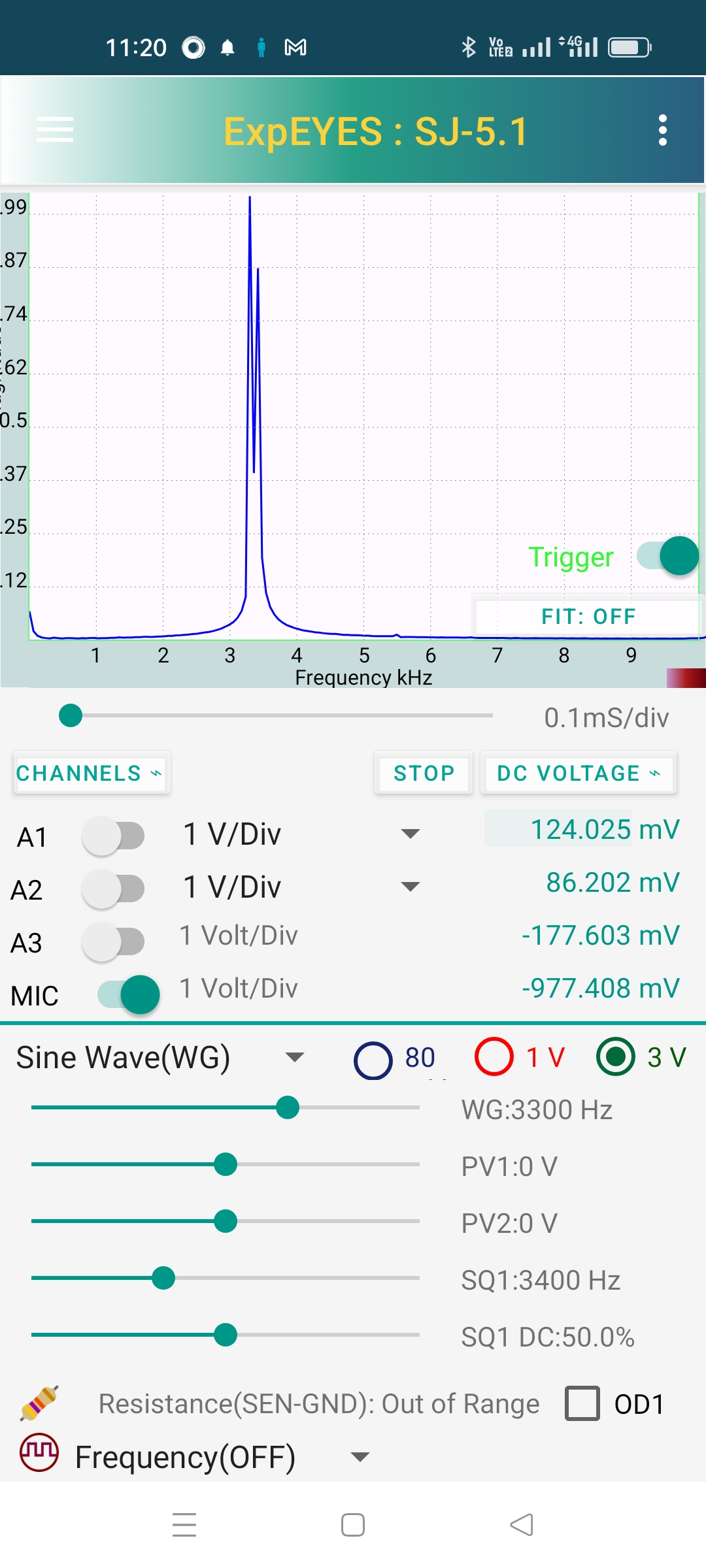
FFT showing both components
6. Observation Table
| Trial | $f_1$ (Hz) | $f_2$ (Hz) | Predicted $ | f_1-f_2 | $ (Hz) | Measured $f_{beat}$ (Hz) | Error (%) |
|---|---|---|---|---|---|---|---|
| 1 | |||||||
| 2 | |||||||
| 3 |
7. Results and Discussion
- Clear beat envelope was observed for nearby frequencies.
-
Measured beat frequency matched $ f_1-f_2 $ within experimental error. - FFT confirmed coexistence of two close frequency components.
8. Precautions
- Keep frequencies close (difference ~50-200 Hz) for visible beats.
- Adjust microphone position to avoid near-field null points.
- Avoid ambient noise and table vibrations during measurement.
9. Troubleshooting
| Symptom | Possible Cause | Corrective Action |
|---|---|---|
| No clear beats | Frequency difference too large/small | Set closer frequencies |
| Very weak envelope | Poor microphone placement | Reposition mic between sources |
| FFT shows one peak only | One source not connected | Verify both buzzer channels |
10. Viva-Voce Questions
Q1. Why do beats occur?
Ans: Due to constructive and destructive interference between two close frequencies.
Q2. Why is beat frequency not equal to average frequency?
Ans: Average frequency gives carrier oscillation, while beat frequency is the envelope rate ($|f_1-f_2|$).