
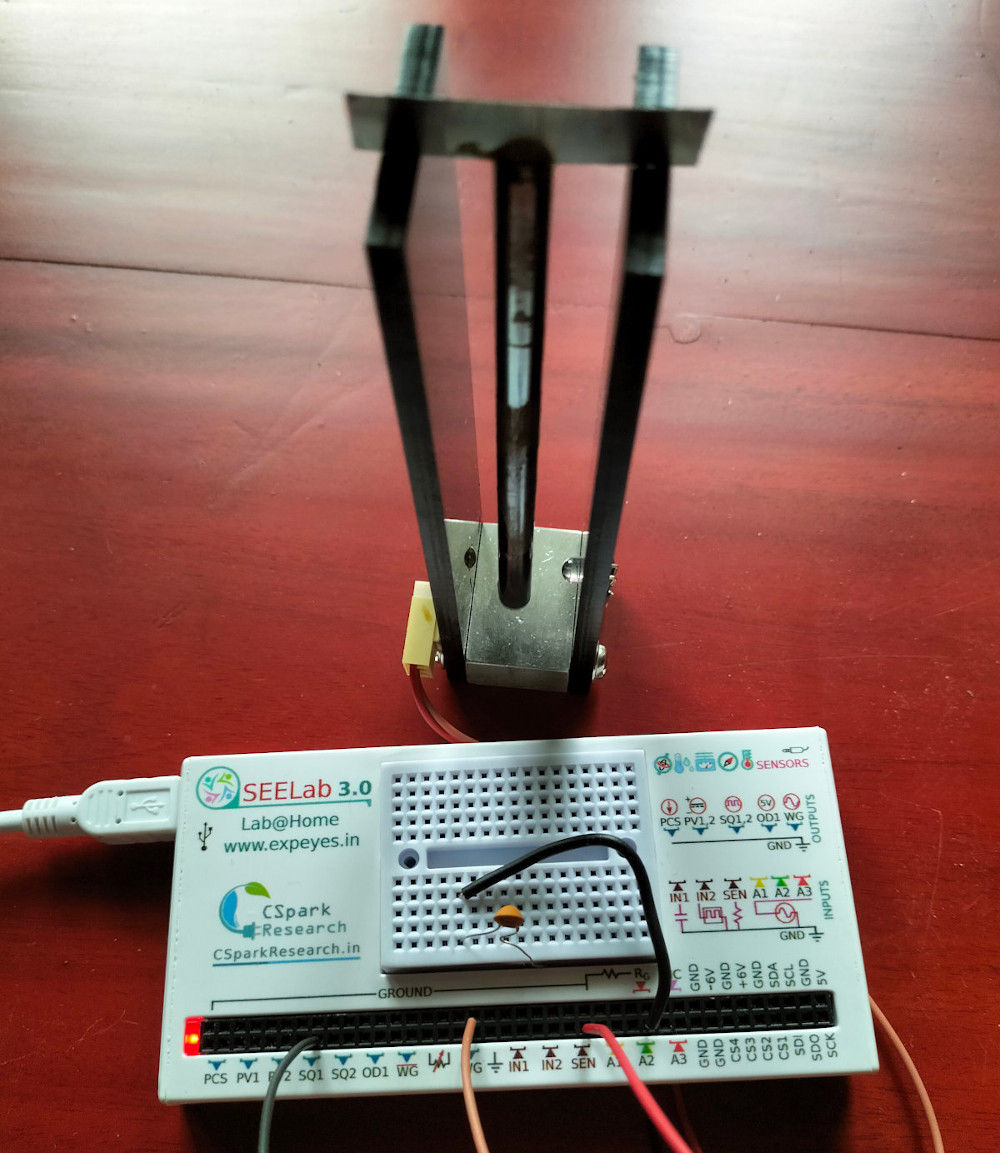
Experiment: Pendulum Period using Light Barrier
1. Aim
To measure pendulum time period with high precision using a light barrier and estimate acceleration due to gravity.
2. Apparatus / Components Required
- SEELab3 unit
- White LED (source)
- Phototransistor (detector)
- Rod pendulum and support stand
- Connecting wires and ruler
- Python/SEELab interface
3. Theory & Principle
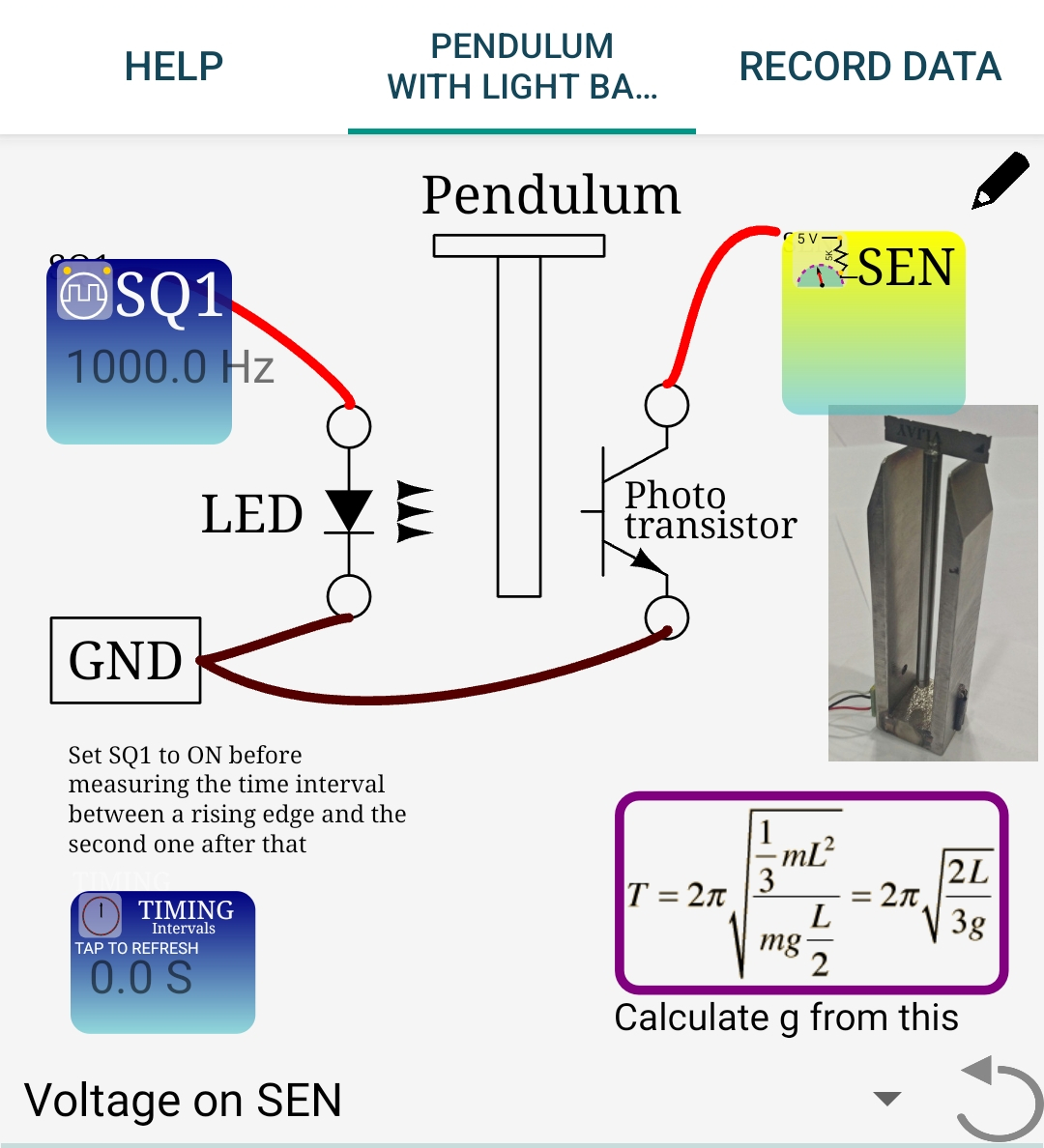
When the pendulum interrupts light between LED and phototransistor, SEN changes logic level. Timing the successive transitions gives period:
\[T = \frac{t_{2\ cycles}}{2}\]For a simple pendulum:
\[T = 2\pi\sqrt{\frac{L}{g}}, \qquad g=\frac{4\pi^2L}{T^2}\]ExpEYES reports period spread around $0.1\text{ ms}$, enabling amplitude-dependence studies.
4. Circuit Diagram / Setup
- Connect LED between SQ1 and GND (SQ1 has internal 100 Ohm series resistor).
- Connect phototransistor collector to SEN, emitter to GND.
- Place pendulum so it cuts the light path during oscillation.
- Test wiring by pulsing SQ1 and observing SEN response.
5. Procedure
- Align LED and phototransistor for clear light interception.
- Set pendulum oscillation at small amplitude.
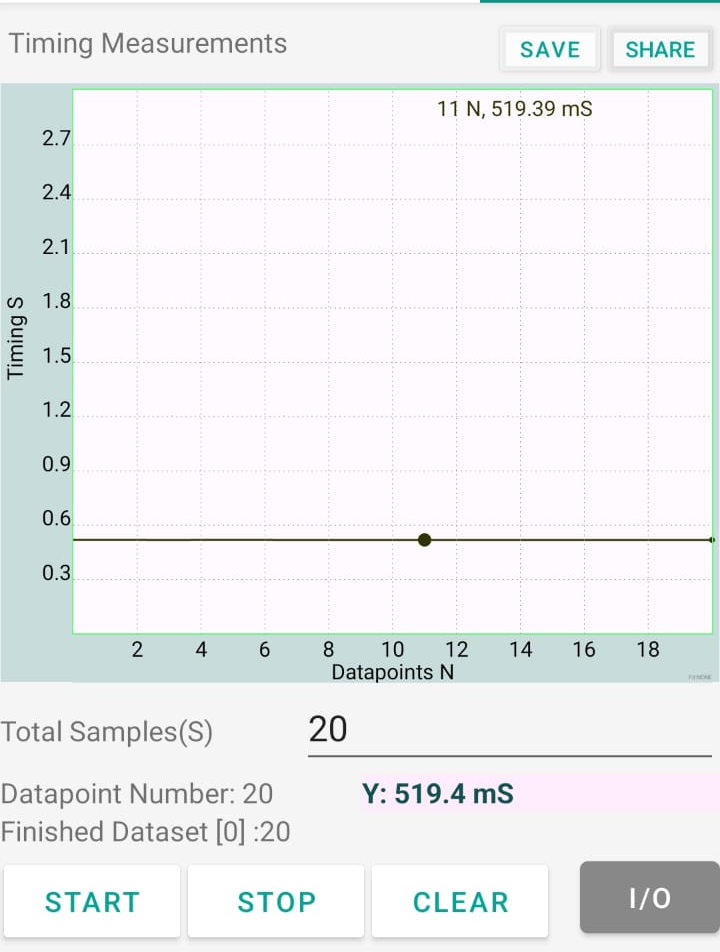
- Measure period repeatedly via GUI/Python (
multi_r2rtime('SEN', 2)). - Record at least 10 values and compute mean and spread.
- Use measured $T$ and pendulum length $L$ to estimate $g$.
- Repeat for larger amplitudes and compare period change.
Screen 1
Screen 2
6. Observation Table
| Trial | Length $L$ (m) | $T$ (s) | $g=4\pi^2L/T^2$ (m/s$^2$) |
|---|---|---|---|
| 1 | |||
| 2 | |||
| 3 | |||
| … | |||
| Mean |
7. Results and Discussion
- High precision timing was achieved with optical interruption sensing.
- Calculated $g$ was close to expected value.
- Spread in period values was very small, suitable for studying non-ideal effects.
8. Precautions
- Keep LED and phototransistor rigidly aligned.
- Ensure pendulum motion is in one plane.
- Measure effective length carefully.
- Keep external light reflections minimal.
9. Troubleshooting
| Symptom | Possible Cause | Corrective Action |
|---|---|---|
| No pulse at SEN | Misalignment or wrong wiring | Re-align optical path and check pins |
| Highly noisy timing | Ambient light fluctuations | Shield detector from room light |
| Large spread in $T$ | Pendulum wobble/twist | Reduce amplitude and improve mounting |
10. Viva-Voce Questions
Q1. Why use light barrier instead of stopwatch?
Ans: It removes human reaction error and gives microsecond-level precision.
Q2. Why does large amplitude alter period?
Ans: Small-angle approximation fails at large angles, increasing period slightly.