
Experiment: Transient Response of an RC Circuit
1. Aim
To study the charging and discharging behavior of a capacitor in a series RC circuit and to determine the Time Constant ($\tau$) by fitting the experimental data.
2. Apparatus / Components Required
- SEELab3 or ExpEYES-17 unit
- One Resistor ($R = 1\text{ k}\Omega$ )
- One Capacitor ($C = 1\text{ }\mu F$ )
- Connecting wires
- PC or Smartphone with SEELab3 software
3. Theory & Principle
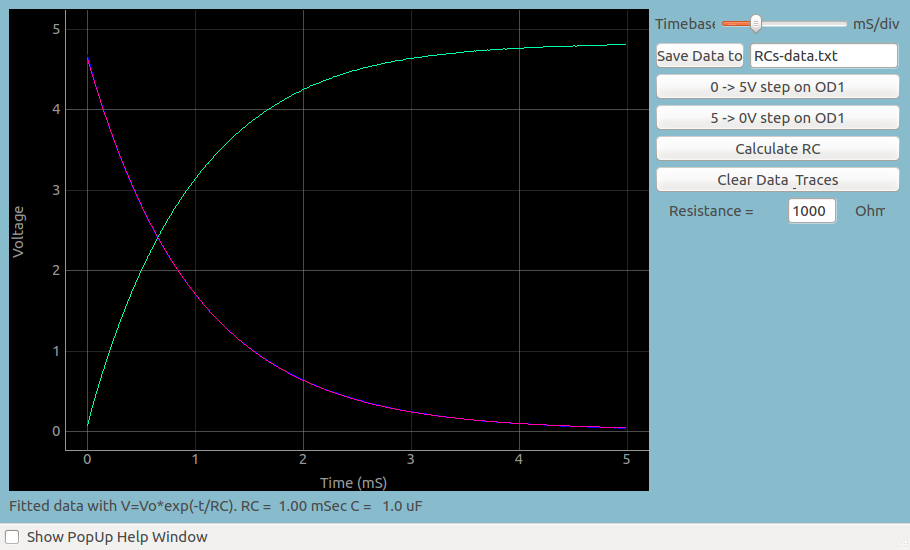
When a voltage step ($V_0$) is applied to an empty capacitor through a resistor, the voltage across the capacitor ($V_C$) does not jump instantly. It increases exponentially according to: \(V_C(t) = V_0(1 - e^{-t/RC})\)
Similarly, when a charged capacitor is allowed to discharge through a resistor, the voltage decays as: \(V_C(t) = V_0 e^{-t/RC}\)
The product $RC$ is called the Time Constant ($\tau$). It represents the time required for the capacitor to charge to approximately $63.2\%$ of the applied voltage or discharge to $36.8\%$ of its initial value.
4. Circuit Diagram / Setup
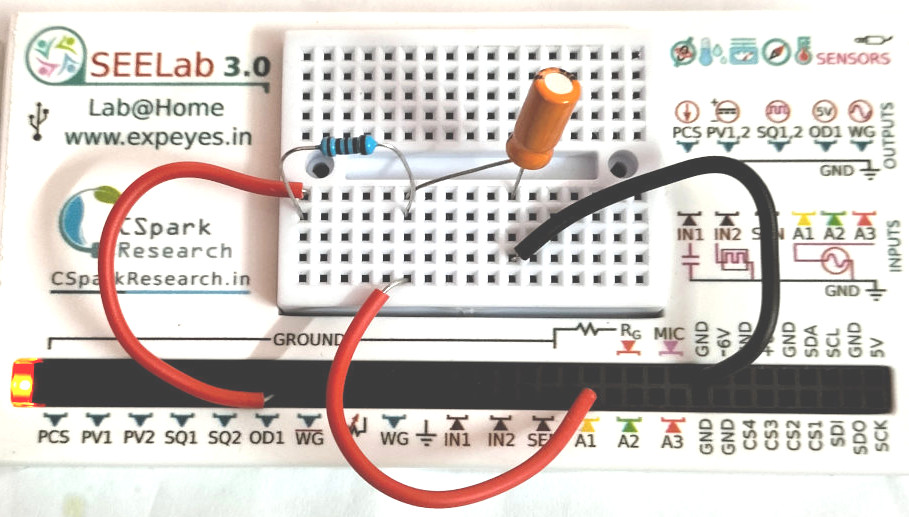
- Series Connection: Connect the Resistor ($R$) and Capacitor ($C$) in series.
- Input Source: Connect the free end of the resistor to OD1 (Digital Output used for the voltage step).
- Ground: Connect the free end of the capacitor to GND.
- Measurement: Connect the junction between the resistor and capacitor to A1 to monitor $V_C$.
5. Procedure
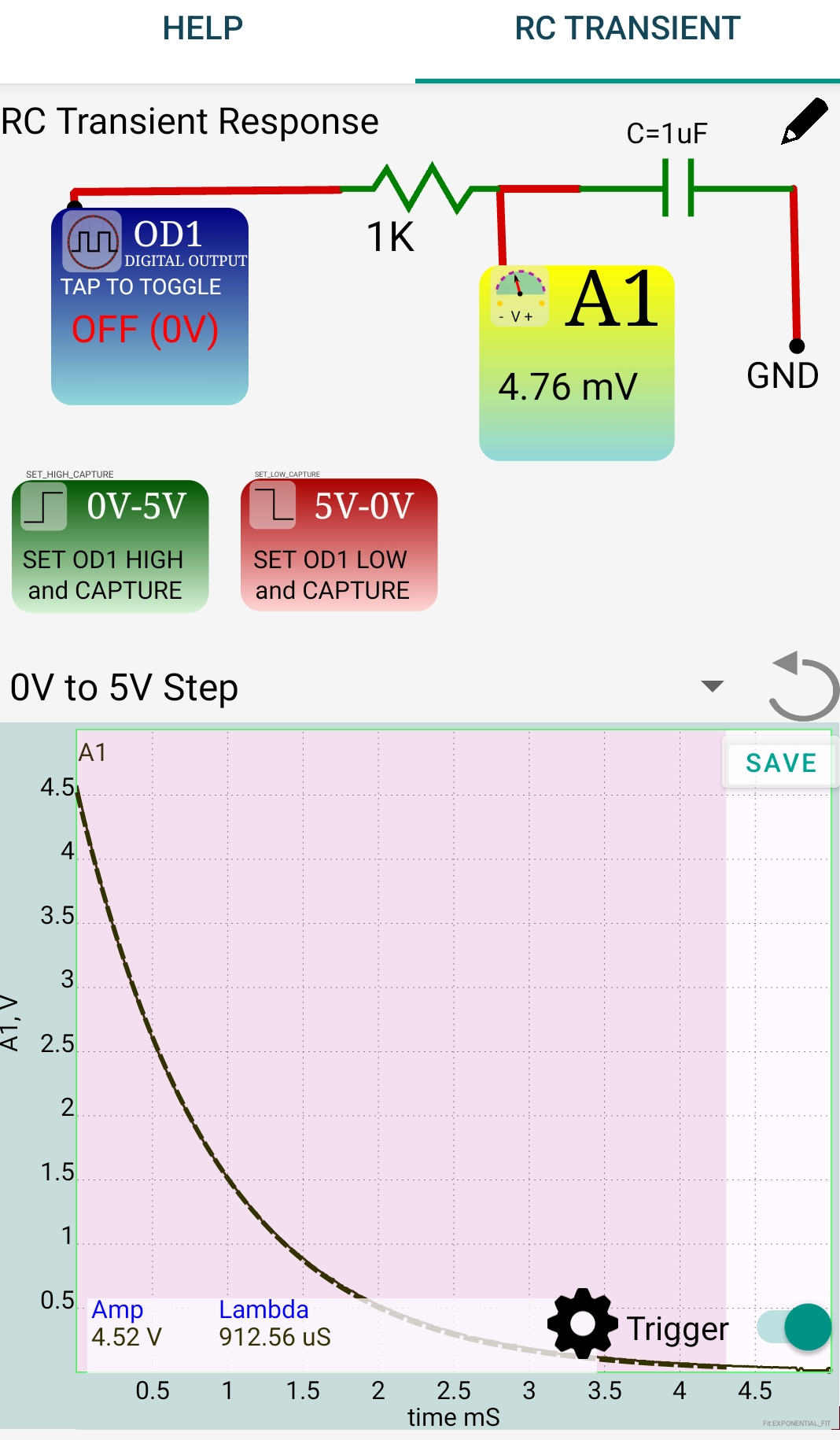
- Open the SEELab3 app and select the “RC Transient” experiment.
- The software is programmed to toggle OD1 from $0V$ to $5V$ and simultaneously start high-speed data acquisition on A1.
- Click on “Charge” (or Start). The software will apply the step and display the rising exponential curve.
- Click on “Discharge”. The software will set OD1 to $0V$ and capture the falling exponential curve.
- Data Fitting: Select a region of the captured curve. Use the “Fit” tool to apply an exponential fit. The software will display the value of the time constant ($RC$).
- Compare the experimental $RC$ value with the theoretical value calculated from the component markings ($R \times C$).
6. Observation Table
| Resistor ($R$): ____ $\Omega$ | Capacitor ($C$): ____ $\mu F$ |
| Process | Theoretical $\tau = RC$ (ms) | Measured $\tau$ from Fit (ms) | % Error |
|---|---|---|---|
| Charging | |||
| Discharging |
7. Results and Discussion
- The voltage across the capacitor followed an exponential path during both charging and discharging phases.
- The measured time constant was found to be ____ ms.
- The results verify that it takes approximately $5\tau$ for the capacitor to reach its steady-state (fully charged or discharged) condition.
8. Precautions
- Selection of RC: Choose $R$ and $C$ values such that the time constant is between $1\text{ ms}$ and $100\text{ ms}$. If $\tau$ is too small, the software may not have enough sampling resolution to capture the curve accurately.
- Input Impedance: The $1\text{ M}\Omega$ input impedance of A1 is in parallel with the capacitor during discharge. For very high $R$ values (e.g., $1\text{ M}\Omega$), this will introduce significant error.
- Residual Charge: Ensure the capacitor is fully discharged before starting a new “Charge” cycle for a clean plot starting from $0V$.
9. Troubleshooting
| Symptom | Possible Cause | Corrective Action |
|---|---|---|
| Graph is a vertical line | $\tau$ is too small. | Increase $R$ or $C$ value to slow down the process. |
| Graph is a flat line at 0V | OD1 not connected. | Check the connection between OD1 and the resistor. |
| Fitting fails/gives error | Noise in data. | Ensure connections are tight; select a cleaner portion of the curve for fitting. |
10. Viva-Voce Questions
Q1. What is the definition of the Time Constant ($\tau$) in an RC circuit?
Ans: It is the time taken by the capacitor to charge to approximately $63\%$ of its maximum voltage or to discharge to $37\%$ of its initial voltage.
Q2. How long does it take for a capacitor to be considered "fully" charged?
Ans: Theoretically, it takes infinite time. However, in practical engineering, a capacitor is considered fully charged after a time interval of $5\tau$, at which point it reaches $>99\%$ of the applied voltage.
Q3. If you double the resistance in a series RC circuit, what happens to the charging time?
Ans: Since $\tau = RC$, doubling the resistance doubles the time constant, meaning the capacitor will take twice as long to charge.
Q4. Why does the current in the circuit decrease as the capacitor charges?
Ans: As the capacitor charges, it develops an EMF that approaches the source voltage. The net voltage across the resistor ($V_0 - V_C$) decreases, and according to Ohm's Law ($I = V_R/R$), the current also decreases.
Q5. What is the initial current ($t=0$) when charging a capacitor?
Ans: At $t=0$, the capacitor acts like a short circuit ($V_C = 0$). Therefore, the initial current is maximum and is equal to $V_0/R$.