
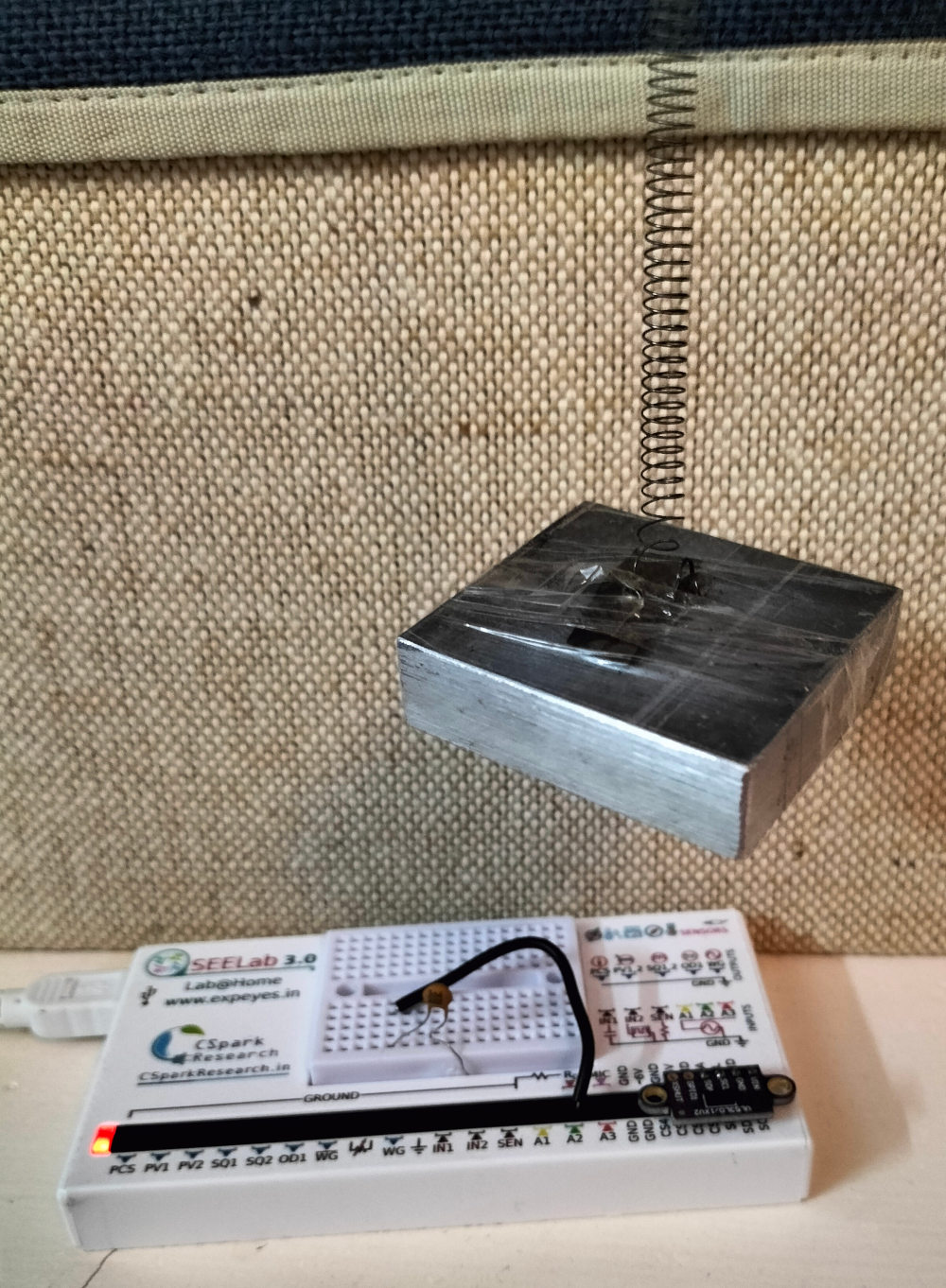
Experiment: Distance Measurement using LIDAR
1. Aim
To measure distance as a function of time using VL53L0X and determine oscillation frequency of a mass-spring system.
2. Apparatus / Components Required
- SEELab3 unit
- VL53L0X I2C LIDAR module
- Spring-mass setup (or fixed target for calibration)
- Connecting wires
- Data plotting/analysis tool
3. Theory & Principle
VL53L0X estimates distance by optical time-of-flight. Recording distance over time for periodic motion and fitting to:
\[x(t)=x_0 + A\sin(2\pi ft+\phi)\]gives oscillation frequency $f$ and period $T=1/f$.
4. Circuit Diagram / Setup
- Connect VL53L0X via I2C interface to SEELab3.
- Verify reading with a static surface.
- Mount sensor facing oscillating mass on spring.
5. Procedure
- Acquire distance-time data for fixed target (baseline check).
- Set spring-mass oscillation and record data.
- Plot distance vs time.
- Fit sinusoidal model and extract frequency.
- Repeat for different masses if needed.
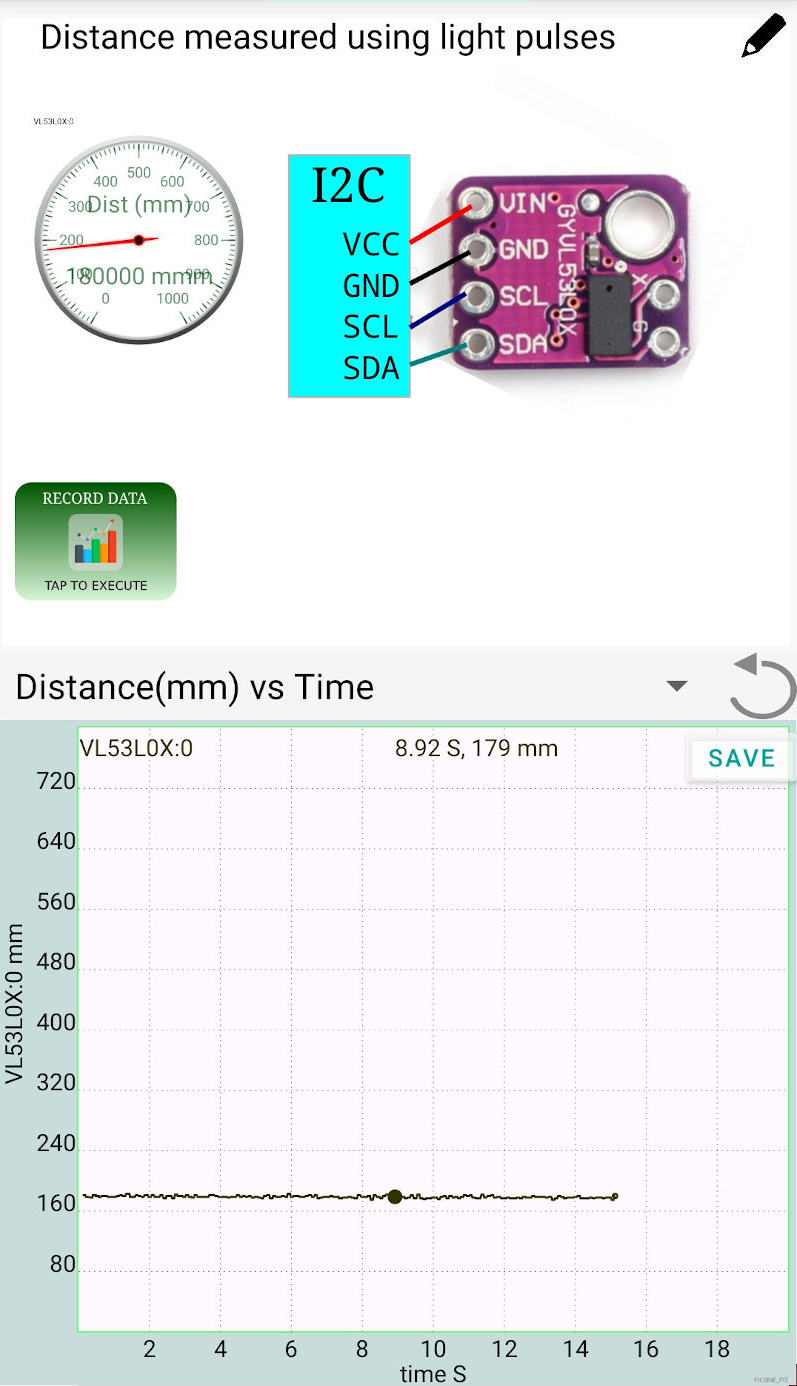
Screen 1
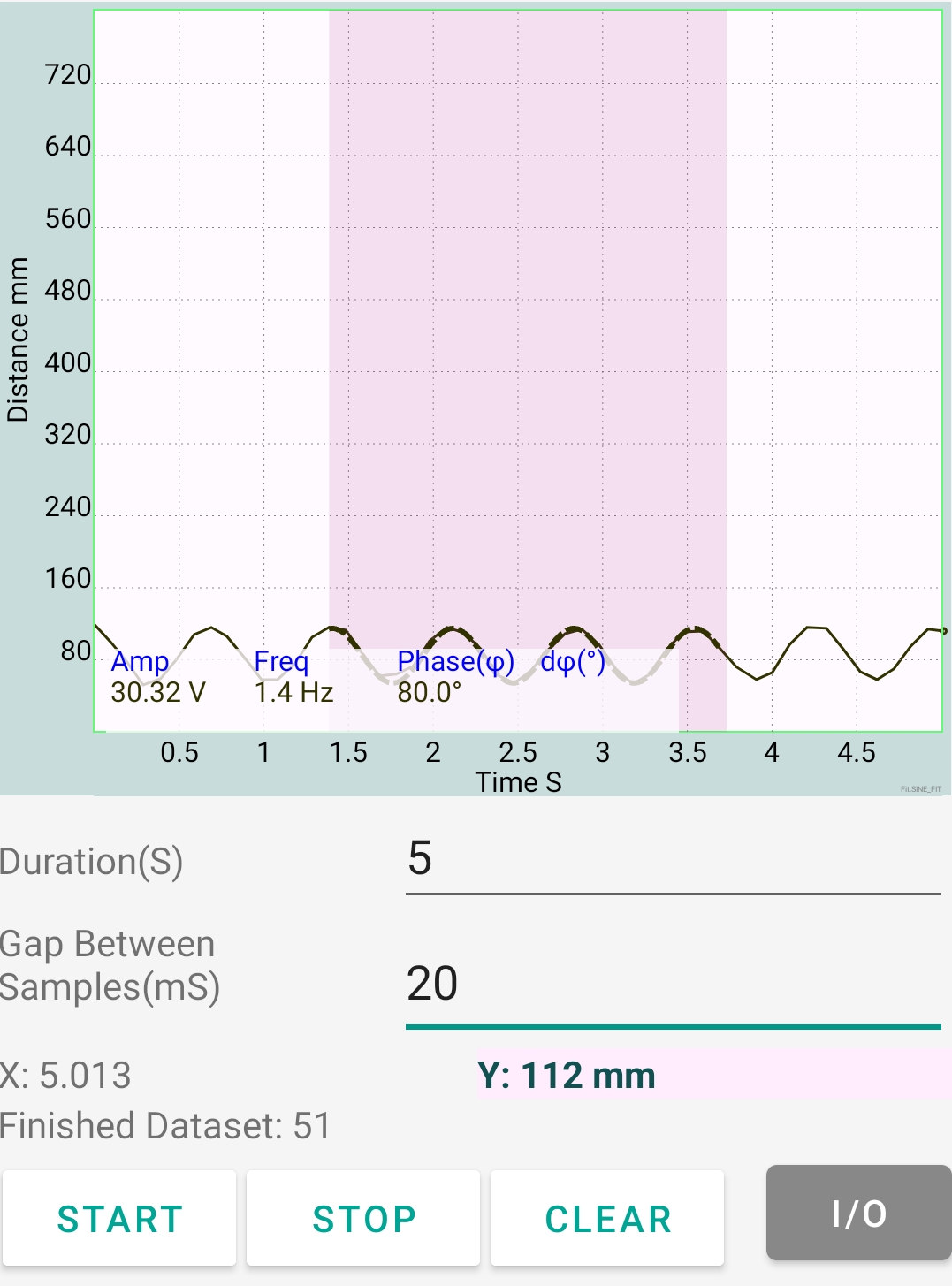
Screen 2
6. Observation Table
| Trial | Mass (g) | Mean distance (cm) | Frequency (Hz) | Period (s) |
|---|---|---|---|---|
| 1 | ||||
| 2 | ||||
| 3 |
7. Results and Discussion
- LIDAR provided non-contact displacement measurement.
- Oscillation frequency was measured as ____ Hz for mass ____ g.
- Non-contact method reduces mechanical loading errors.
8. Precautions
- Keep target reflectivity adequate and stable.
- Avoid strong ambient IR interference.
- Align sensor normal to target motion direction.
9. Troubleshooting
| Symptom | Possible Cause | Corrective Action |
|---|---|---|
| No distance output | I2C miswiring | Check SDA/SCL and power pins |
| Highly noisy signal | Bad alignment/reflectivity | Realign and use reflective surface |
| Incorrect fit | Non-sinusoidal motion | Reduce damping and use clean oscillation |
10. Viva-Voce Questions
Q1. Why use LIDAR for oscillation measurement?
Ans: It provides non-contact, high-resolution position sensing over time.
Q2. How is frequency extracted from distance data?
Ans: By fitting the recorded waveform with a sinusoidal function and reading fitted frequency parameter.