
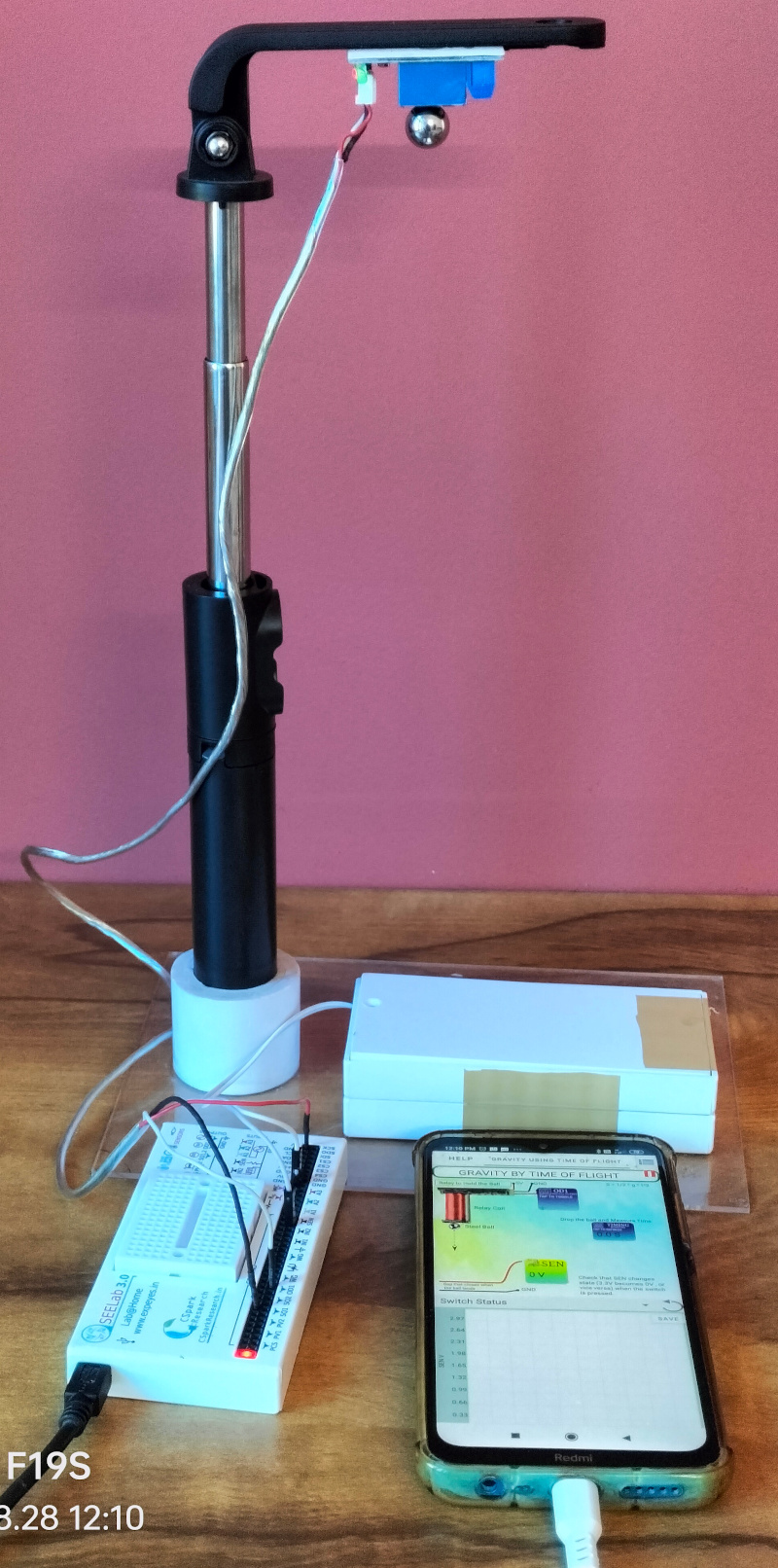
Experiment: Determination of g by Time of Flight
1. Aim
To determine acceleration due to gravity by measuring time taken by a freely falling steel ball over a known distance.
2. Apparatus / Components Required
- SEELab3 unit
- Electromagnet release assembly
- Mild steel ball
- Contact sensor plate
- Scale/ruler for measuring drop distance
- Python scripts (
tof.py,tof-analyse.py)
3. Theory & Principle
For free fall from rest:
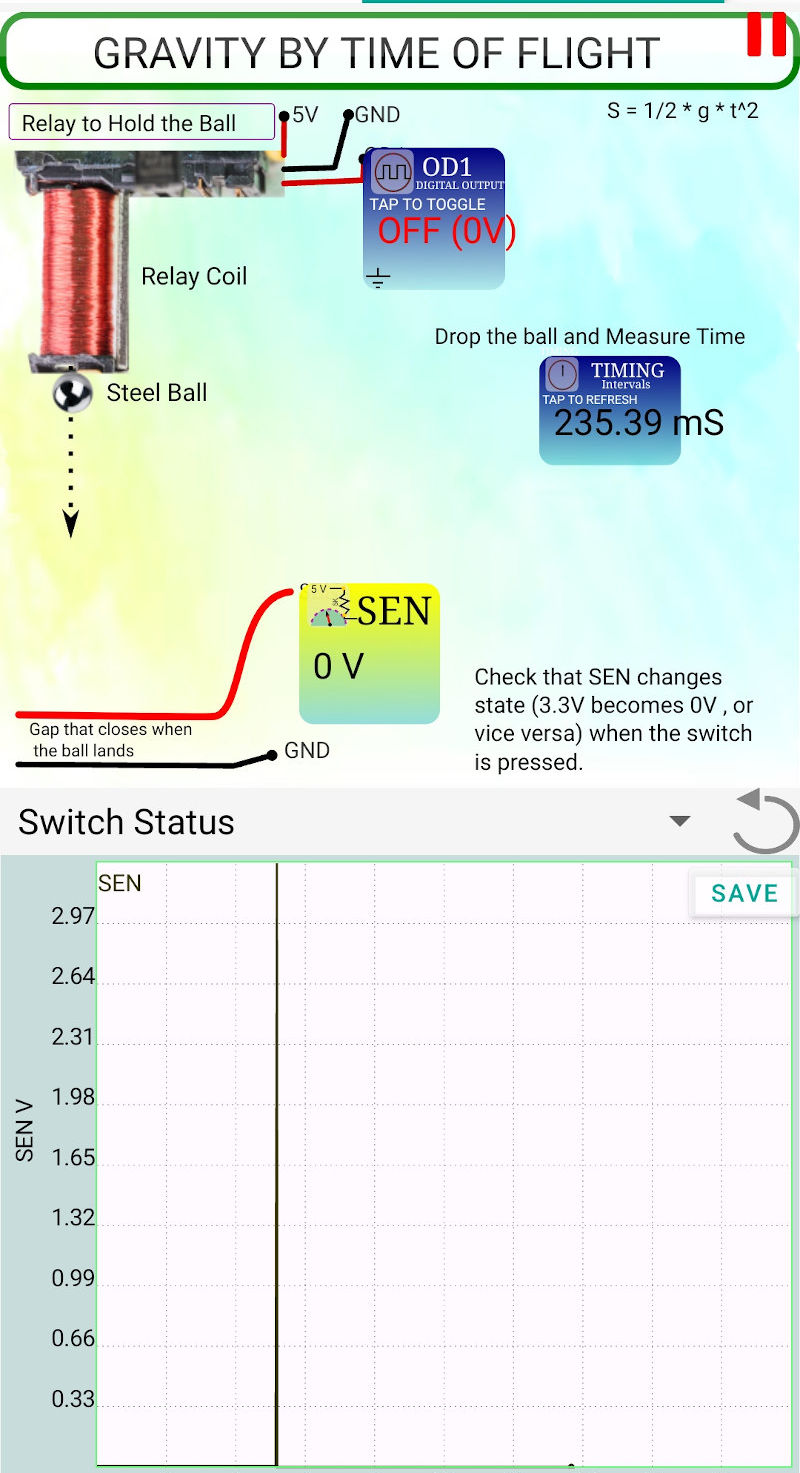
\[S=\frac{1}{2}gt^2 \quad \Rightarrow \quad g=\frac{2S}{t^2}\]Measure drop height $S$ and time of flight $t$ to compute $g$.
Example from setup: $S=27\text{ cm}$ with $t\approx0.2354\text{ s}$ gives $g\approx974.5\text{ cm/s}^2$.
4. Circuit Diagram / Setup
- Fix electromagnet at known height.
- Place contact sensor directly below drop path.
- Hold steel ball with electromagnet and release under software control.
- Measure vertical distance from ball’s lowest point to sensor.
5. Procedure
- Measure $S$ accurately.
- Perform one release and verify trigger timings.
- Run repeated trials (50-100 readings recommended).
- Save time data (
tof.csv). - Compute $g$ for each reading.
- Plot histogram and fit Gaussian for random error estimate.
6. Observation Table
| Trial | $S$ (m) | $t$ (s) | $g=2S/t^2$ (m/s$^2$) |
|---|---|---|---|
| 1 | |||
| 2 | |||
| 3 | |||
| … | |||
| Mean |
7. Results and Discussion
- Measured mean value of $g$ was ____ m/s$^2$.
- Distribution width indicated timing repeatability of ____.
- Systematic error can arise from delayed mechanical release after magnet de-energizing.
8. Precautions
- Keep ball release point fixed for all trials.
- Ensure sensor contact is reliable and noise-free.
- Minimize lateral motion during release.
- Use enough trials to separate random and systematic error.
9. Troubleshooting
| Symptom | Possible Cause | Corrective Action |
|---|---|---|
| Very high/low $g$ | Wrong distance reference | Re-measure $S$ from correct point |
| Large scatter in $t$ | Irregular release mechanics | Improve magnet-ball alignment |
| Missed impacts | Sensor contact issue | Recheck contact plate wiring |
10. Viva-Voce Questions
Q1. Why does delayed release affect measured g?
Ans: Timing starts before actual free fall if magnetic hold decays slowly, increasing measured $t$ and lowering calculated $g$.
Q2. Why take many trials?
Ans: To estimate uncertainty and separate random fluctuations from systematic bias.