
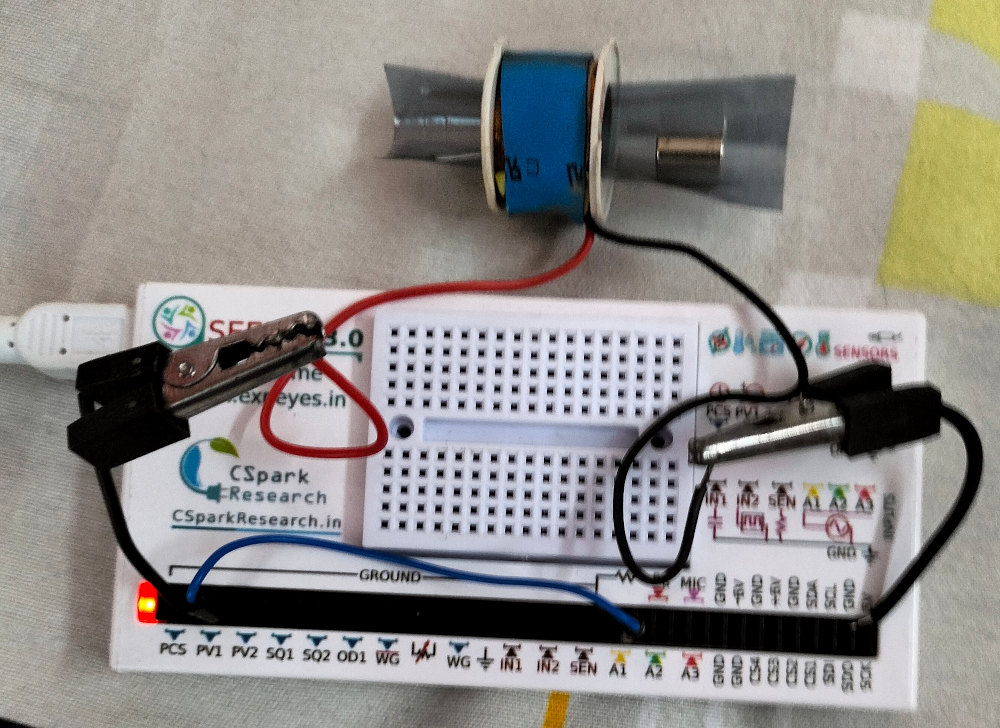
Experiment: Study of an Electromagnet
1. Aim
To demonstrate that a current-carrying conductor produces a magnetic field and to study the properties of an electromagnet using a solenoid coil and a permanent magnet.
2. Apparatus / Components Required
- SEELab3 or ExpEYES-17 unit
- Solenoid coil (e.g., 3000 turns of SWG44 wire included in the kit)
- Small permanent bar magnet or a Compass
- Connecting wires
- PC or Smartphone with SEELab3 software
3. Theory & Principle
When an electric current ($I$) flows through a conductor, it creates a magnetic field around it (Oersted’s discovery). A Solenoid is a long coil of wire consisting of many loops. When current passes through it, the magnetic fields of the individual loops add together to create a strong, uniform magnetic field inside the coil, behaving like a bar magnet.
The magnetic field strength ($B$) at the center of a long solenoid is given by: \(B = \mu_0 \cdot n \cdot I\)
Where:
- $B$ is the magnetic flux density in Tesla ($T$).
- $\mu_0$ is the permeability of free space ($4\pi \times 10^{-7} \text{ T}\cdot\text{m/A}$).
- $n$ is the number of turns per unit length ($N/L$).
- $I$ is the current in Amperes ($A$).
Current Limitation: The Programmable Voltage source (PV1) on SEELab3/ExpEYES has a maximum current limit of 30mA.
- The standard coil provided (3000 turns) has a resistance ($R$) of approximately $500\text{ }\Omega$.
- At $5V$, the current drawn is $I = V/R = 5/500 = 10\text{ mA}$, which is well within the limit.
4. Circuit Diagram / Setup
- Connect one end of the solenoid coil to PV1 and the other end to GND.
- Connect PV1 to A1 using a wire to monitor the actual voltage applied across the coil.
- Place a small permanent magnet or a compass needle near one end of the coil, aligned with its axis.
5. Procedure
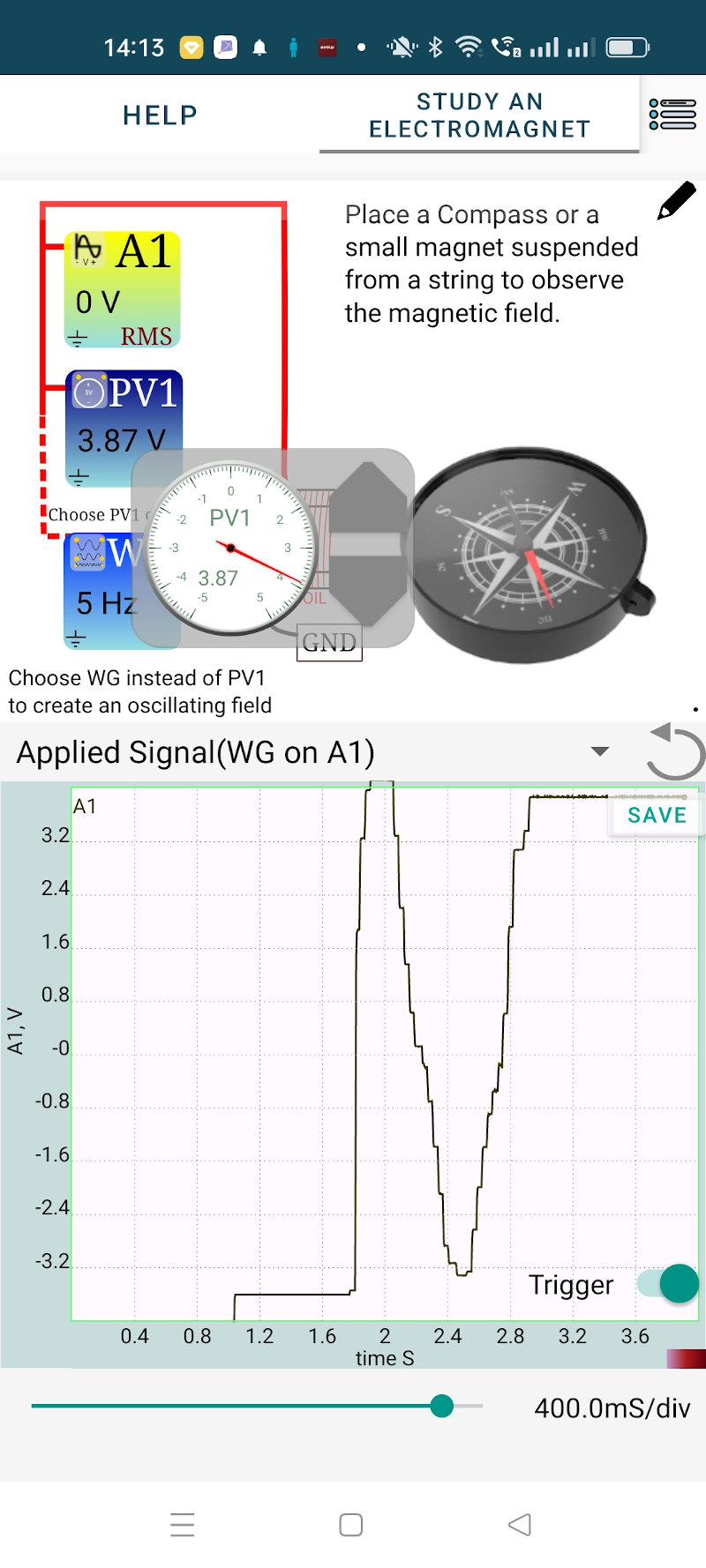
- Open the SEELab3 software and select the “Electromagnet” or “Power Supply” tool.
- Set the voltage at PV1 to $0V$.
- Slowly increase the voltage to $+5V$ and observe the movement of the magnet (Attraction or Repulsion).
- Change the voltage to $-5V$ (reverse polarity) and observe how the magnetic poles of the coil flip, causing the opposite force on the permanent magnet.
- AC Study: Set the Waveform Generator (WG) to a low frequency (e.g., $5\text{ Hz}$) and connect it to the coil to see the magnet vibrate as the poles oscillate.
6. Observation Table
Coil Resistance ($R$): ____ $\Omega$
| Set Voltage (V) | Measured Voltage A1 (V) | Current $I \approx V_{A1}/R$ (mA) | Observation (Attract/Repulse) |
|---|---|---|---|
| +5.0 | |||
| +2.5 | |||
| -2.5 | |||
| -5.0 |
7. Error Analysis
- Voltage Drop: If the measured voltage at A1 is lower than the set PV1 value, it indicates that the coil resistance is too low, hitting the $30\text{ mA}$ safety limit of the device.
- Ambient Fields: Nearby electronic devices or large metal objects can distort the magnetic field, affecting the compass needle or magnet movement.
- Thermal Drift: As the coil carries current, it heats up, which slightly increases its resistance ($R = R_0[1 + \alpha\Delta T]$), thereby decreasing the current and the magnetic field strength over time. Although this effect will not present itself for such low currents.
8. Results and Discussion
- The coil behaves as a magnet when current flows through it, confirming the magnetic effect of electric current.
- Reversing the direction of the current reverses the polarity of the electromagnet.
- The strength of the electromagnet is directly proportional to the magnitude of the current flowing through it.
9. Precautions
- Current Limit: Do not use coils with resistance less than $170\text{ }\Omega$ at $5V$ to avoid overloading the source.
- Heat: Do not leave the current running through the coil for extended periods.
- Interference: Keep sensitive electronic devices away from the strong magnetic field.
10. Troubleshooting
| Symptom | Possible Cause | Corrective Action |
|---|---|---|
| No magnetic force | Broken coil wire. | Check continuity using the SEELab ohmmeter. |
| Voltage A1 < Set PV1 | Current limit reached. | Use a higher resistance coil or lower the voltage. |
| Magnet doesn’t move | Magnet is too far. | Move the magnet closer to the center of the coil. |
11. Viva-Voce Questions
Q1. What happens to the magnetic field if you insert an iron core into the solenoid?
Ans: The magnetic field strength increases significantly. Iron has a high magnetic permeability, which concentrates the magnetic flux lines, making the electromagnet much stronger.
Q2. How can you determine the North and South poles of an electromagnet?
Ans: You can use the Right-Hand Thumb Rule: Curl your fingers in the direction of the current flow; your thumb will point toward the North pole. Alternatively, use a magnetic compass.
Q3. Why does the magnet vibrate when the coil is connected to the Waveform Generator (WG)?
Ans: The WG provides Alternating Current (AC), which reverses direction periodically. This causes the poles of the electromagnet to flip back and forth, alternating between attracting and repelling the permanent magnet.
Q4. On what factors does the strength of an electromagnet depend?
Ans: It depends on the number of turns in the coil ($N$), the magnitude of the current ($I$), and the permeability of the core material ($\mu$).
Q5. Is an electromagnet a permanent magnet or a temporary magnet?
Ans: It is a temporary magnet. Its magnetic field exists only as long as an electric current is flowing through the coil.