
Experiment: Measurement of DC Resistance of the Human Body
1. Aim
To measure the electrical resistance offered by the human body to a DC voltage using the SEELab3/ExpEYES toolkit and to observe how physical conditions like moisture and contact area affect this value.
2. Apparatus / Components Required
- SEELab3 or ExpEYES-17 Test & Measurement Tool
- Set of connecting wires
- A PC, Laptop, or Android Phone with SEELab3 software installed
- Metal coins (optional, to test the effect of surface area)
3. Theory & Principle
The human body acts as a conductor, though it offers significant resistance primarily due to the dry outer layer of the skin (stratum corneum). In this experiment, the body is treated as a component in a Potential Divider Network.
The SEELab3 device has a known internal input impedance ($R_{in}$) at the A2 terminal, typically $1\text{ M}\Omega$. When you connect your body between the voltage source (PV1) and the input terminal (A2), the voltage measured at A2 ($V_{A2}$) is determined by:
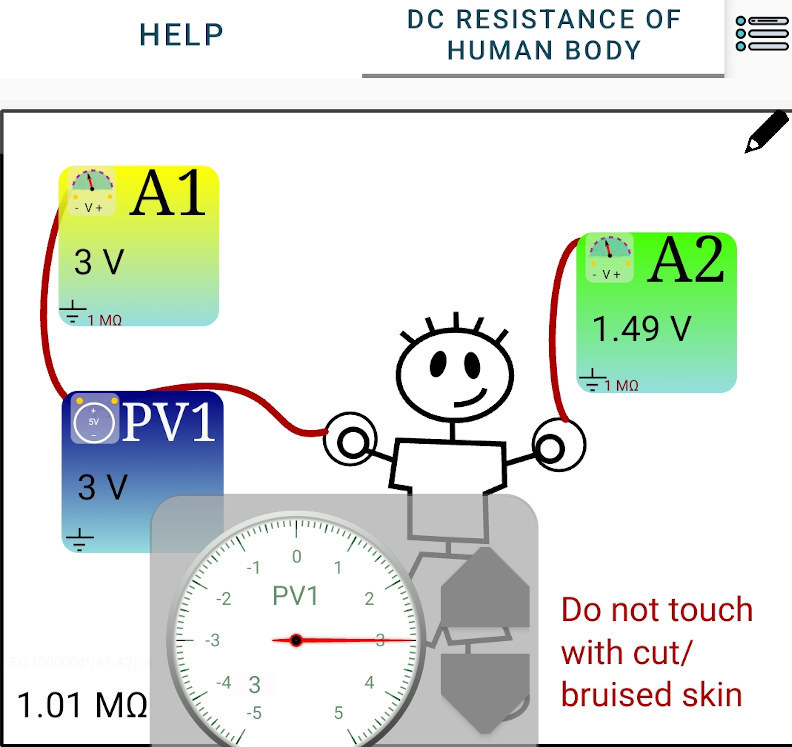
\[V_{A2} = V_{PV1} \times \frac{R_{in}}{R_{body} + R_{in}}\]By measuring the voltage drop, the software calculates $R_{body}$ using Ohm’s Law. For example, if your body offers exactly $1\text{ M}\Omega$ of resistance, the voltage at A2 will be exactly half of the voltage supplied by PV1.
4. Circuit Diagram / Setup
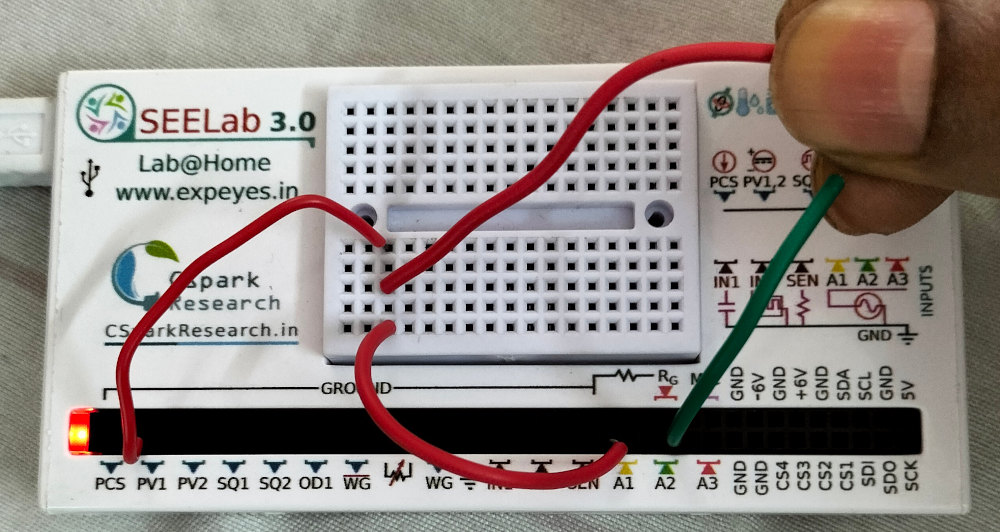
- Connect a wire from PV1 to A1 to monitor the source voltage.
- Connect a second wire to PV1 and hold its metal tip firmly with your left hand.
- Connect a third wire to A2 and hold it with your right hand.
- The circuit is completed through your chest and arms, flowing from PV1 to A2.
5. Procedure
- Launch the SEELab3 software and navigate to the “DC Resistance of Human Body” experiment.
- Hold the bare end of the PV1 wire in one hand and the A2 wire in the other.
- Observe the resistance value displayed on the software interface.
- Test for Surface Area: Place a metal coin between your fingers and the wire tips to increase the contact area and note the change.
- Test for Moisture: Dampen your fingertips slightly with water and repeat the measurement.
6. Observation Table
Reference Impedance ($R_{in}$): $1.0\text{ M}\Omega$
| Condition | Voltage at PV1 (V) | Voltage at A2 (V) | Measured Resistance ($M\Omega$) |
|---|---|---|---|
| Dry Hands (Finger Tip) | |||
| Dry Hands (Holding Coins) | |||
| Wet Hands |
7. Error Analysis
- Contact Pressure: Variable pressure on the wire tips changes the effective contact area, leading to fluctuating resistance values.
- Internal Impedance Tolerance: The $1\text{ M}\Omega$ internal resistance of A2 may have a $\pm 1\%$ tolerance, which directly affects the calculated $R_{body}$.
- Sweat and Electrolytes: Natural salts on the skin can create a parallel conductive path, making the “dry” reading vary significantly between different individuals.
8. Results and Discussion
- The DC resistance of the human body was found to be approximately ____ $M\Omega$ under normal dry conditions.
- Observation on Area: Increasing the contact area using coins decreased the measured resistance. This follows the formula $R = \rho L/A$.
- Observation on Moisture: Wetting the hands decreased the resistance significantly, as water provides a much better conductive path through the skin’s surface.
9. Precautions
- Consistent Contact: Ensure the wires make firm contact with the skin; loose contact will lead to erratic resistance calculations.
- Voltage Safety: Use only the low-voltage DC outputs (PV1) provided by the SEELab3. Never connect the inputs to AC mains.
- Software Selection: Ensure the correct hardware model is selected in the software settings so the internal $1\text{ M}\Omega$ impedance is correctly factored.
10. Troubleshooting
| Symptom | Possible Cause | Corrective Action |
|---|---|---|
| Resistance shows $\infty$ | Open circuit. | Ensure you are holding the metal tips of both wires firmly. |
| Resistance shows $0\text{ }\Omega$ | Short circuit. | Ensure the PV1 and A2 wires are not touching each other. |
| Unstable Readings | Electrical noise. | Hold wires steadily; try running the laptop on battery power. |
11. Viva-Voce Questions
Q1. Why does wetting your hands decrease the measured resistance?
Ans: Dry skin is a poor conductor. Water (especially with dissolved skin salts) acts as an electrolyte that allows ions to move more freely, significantly increasing the conductivity and lowering the overall resistance.
Q2. In this experiment, what acts as the "Voltmeter" and what acts as the "Load"?
Ans: The A2 terminal (with its $1\text{ M}\Omega$ internal resistance) acts as the voltmeter, and the human body acts as the load resistor connected in series with it.
Q3. How does the path of the current change if you hold both wires in the same hand?
Ans: The current path becomes much shorter (just through the palm or fingers of one hand) rather than through the arms and chest. This will result in a much lower resistance reading.
Q4. Why do we use a high input impedance terminal like A2 for this measurement?
Ans: Since human body resistance is very high (often in the $M\Omega$ range), we need a measuring device with a comparable internal resistance ($1\text{ M}\Omega$) to create a measurable voltage drop in the potential divider.
Q5. Is the human body's resistance purely Ohmic (constant)?
Ans: No. Human resistance is non-linear and depends on voltage, frequency, and biological factors. High voltages can actually "break down" the skin's resistance, which is why high-voltage shocks are so dangerous.