Velocity of Sound in Air
Velocity of Sound in Air
1. Aim
To determine velocity of sound in air using phase difference between reference waveform and microphone signal.
2. Apparatus / Components Required
- SEELab3 unit
- Piezo buzzer (sound source)
- Microphone/pressure sensor
- Scale/ruler
- Stands and connecting wires
3. Theory & Principle
For a sinusoidal wave: \[v = f\lambda\]
If two positions differ by 180 degrees phase, separation equals $\lambda/2$.
Hence: \[v = 2f\Delta x\]
where $\Delta x$ is distance shift between in-phase and out-of-phase conditions.
4. Circuit Diagram / Setup
- Drive piezo with WG at fixed frequency (around 3400 Hz).
- Measure WG as reference and MIC as received signal.
- Move microphone along the source axis and monitor phase relation.
5. Procedure
- Set WG frequency near buzzer resonance.
- Find microphone position where WG and MIC are in phase.
- Find position where they are 180 degrees out of phase.
- Measure displacement $\Delta x$ between these positions.
- Compute velocity: $v = 2f\Delta x$.
- Repeat multiple times and average.
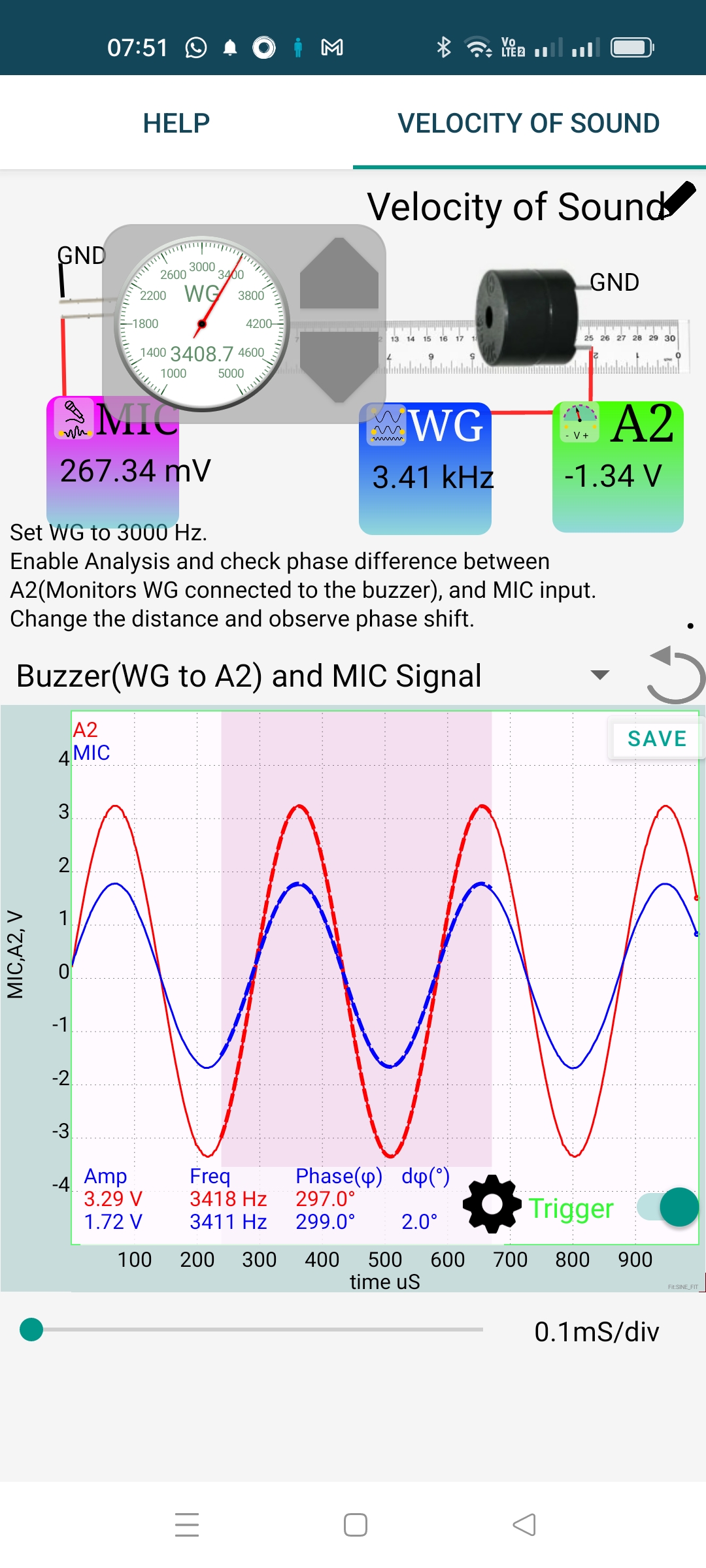
Screen 1
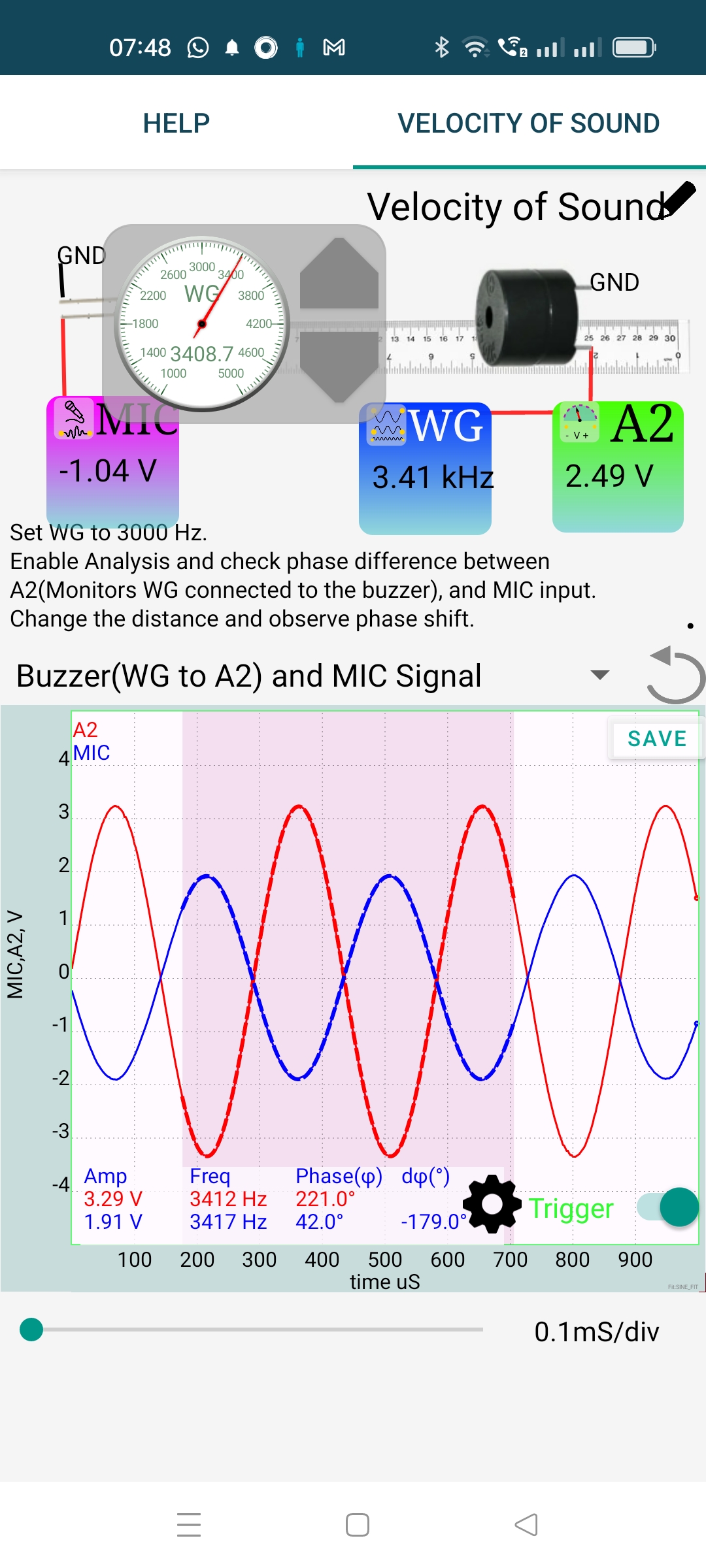
Screen 2
6. Observation Table
| Trial | Frequency $f$ (Hz) | In-phase position (cm) | 180 degrees position (cm) | $\Delta x$ (m) | $v=2f\Delta x$ (m/s) |
|---|---|---|---|---|---|
| 1 | |||||
| 2 | |||||
| 3 |
7. Results and Discussion
- Measured velocity of sound: ____ m/s.
- Value is affected by reflections and alignment errors.
- Measurement quality improves in open space with fewer reflecting surfaces.
8. Precautions
- Keep source and microphone collinear.
- Minimize reflections from nearby walls/objects.
- Use stable frequency and avoid touching setup during measurement.
9. Troubleshooting
| Symptom | Possible Cause | Corrective Action |
|---|---|---|
| Phase relation unclear | Weak signal or noisy environment | Increase signal level and reduce ambient noise |
| Unrealistic velocity | Distance reading error | Re-measure positions carefully |
| Unstable waveform | Poor microphone placement | Fix sensor position and orientation |
10. Viva-Voce Questions
Q1. Why does 180 degrees phase shift correspond to half wavelength?
Ans: A full wavelength corresponds to 360 degrees; half of it gives 180 degrees.
Q2. Why are results often slightly high/low?
Ans: Reflections and phase-reading uncertainty shift effective path difference.