Interference of Sound (Beats)
Interference of Sound (Beats)
1. Aim
To observe acoustic beats formed by superposition of two nearby frequencies and verify that beat frequency equals frequency difference.
2. Apparatus / Components Required
- SEELab3 unit
- Two piezo buzzers
- Microphone module
- Mounting wire/support for microphone near I2C socket
- Connecting wires
3. Theory & Principle
When two sinusoidal waves of close frequencies $f_1$ and $f_2$ superpose, the resultant amplitude varies slowly, producing beats. \[f_{beat} = |f_1 - f_2|\]
In this setup, typical drive values are around:
- buzzer 1: 3300 Hz sine
- buzzer 2: 3400 Hz square/sine
Expected beat frequency is approximately 100 Hz.
4. Circuit Diagram / Setup
- Connect both buzzers to signal outputs as per ExpEYES arrangement.
- Place microphone between/near the two buzzers and secure mechanically.
- Adjust relative distances to maximize envelope visibility.
- Capture waveform and FFT using SEELab interface.
5. Procedure
- Set two close but distinct frequencies.
- Start acquisition and observe amplitude modulation envelope.
- Measure time between successive envelope maxima to get beat period $T_b$.
- Compute beat frequency:
Verify against $ f_1-f_2 $. - Open FFT and confirm both source frequency peaks are present.
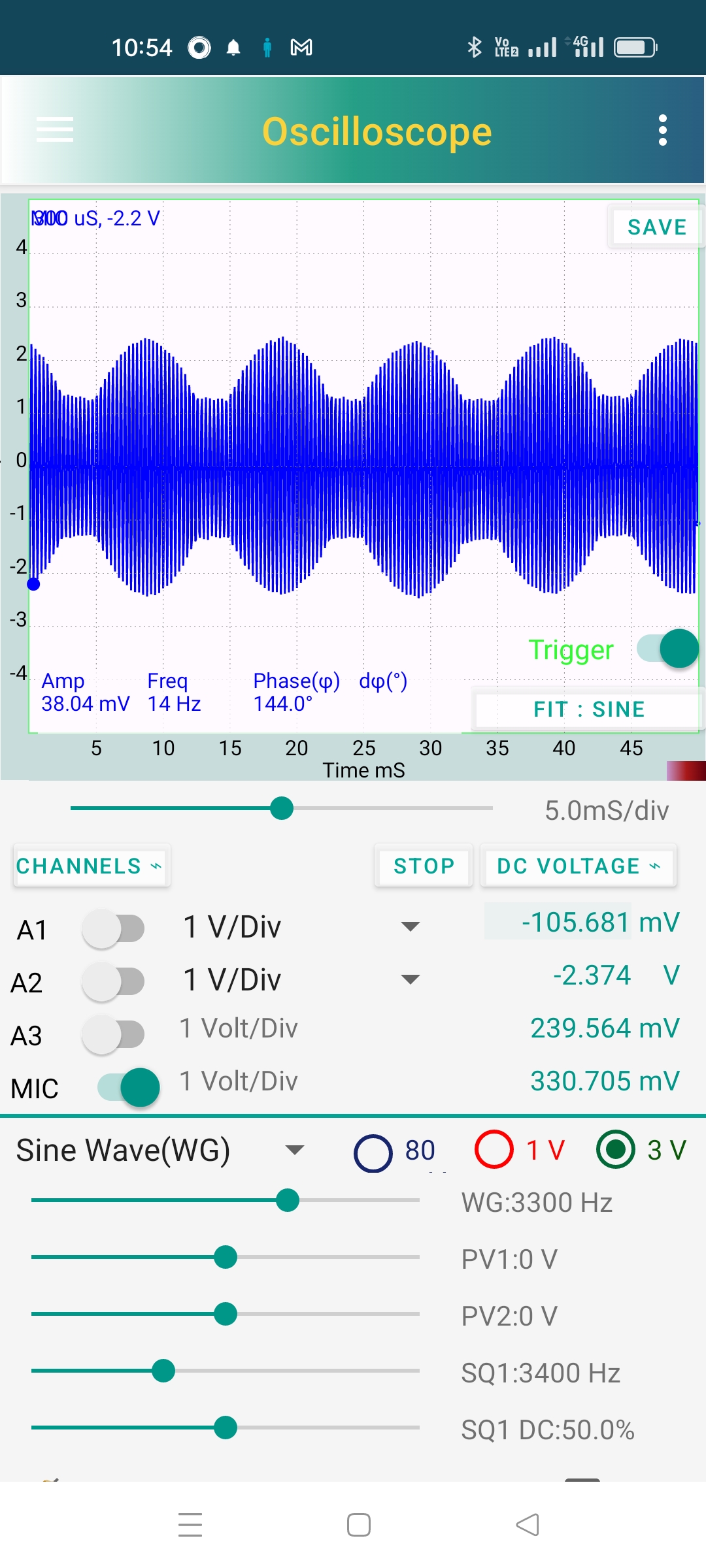
Waveform with Beat Envelope
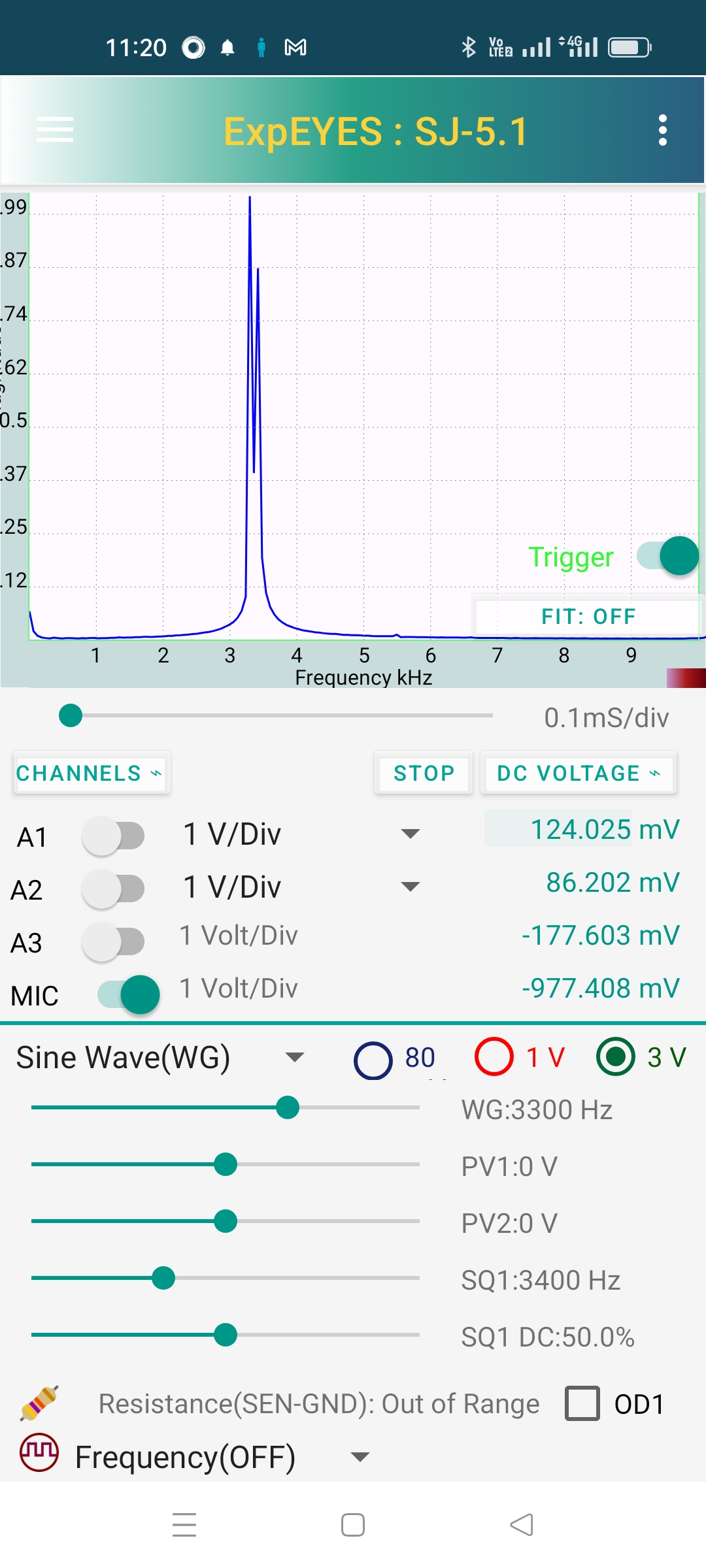
FFT showing both components
6. Observation Table
| Trial | $f_1$ (Hz) | $f_2$ (Hz) | Predicted $ | f_1-f_2 | $ (Hz) | Measured $f_{beat}$ (Hz) | Error (%) |
|---|---|---|---|---|---|---|---|
| 1 | |||||||
| 2 | |||||||
| 3 |
7. Results and Discussion
- Clear beat envelope was observed for nearby frequencies.
Measured beat frequency matched $ f_1-f_2 $ within experimental error. - FFT confirmed coexistence of two close frequency components.
8. Precautions
- Keep frequencies close (difference ~50-200 Hz) for visible beats.
- Adjust microphone position to avoid near-field null points.
- Avoid ambient noise and table vibrations during measurement.
9. Troubleshooting
| Symptom | Possible Cause | Corrective Action |
|---|---|---|
| No clear beats | Frequency difference too large/small | Set closer frequencies |
| Very weak envelope | Poor microphone placement | Reposition mic between sources |
| FFT shows one peak only | One source not connected | Verify both buzzer channels |
10. Viva-Voce Questions
Q1. Why do beats occur?
Ans: Due to constructive and destructive interference between two close frequencies.
Q2. Why is beat frequency not equal to average frequency?
Ans: Average frequency gives carrier oscillation, while beat frequency is the envelope rate ($|f_1-f_2|$).